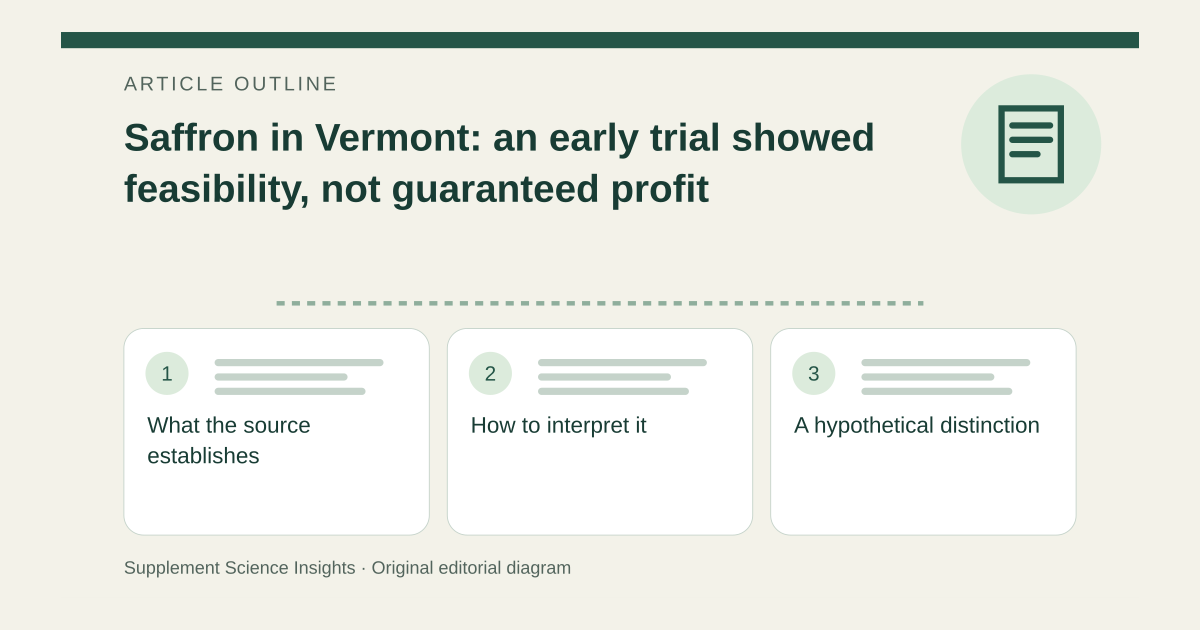
What the source establishes
The project grew nearly 24,000 crocus plants in a protected Vermont setting. Researchers compared movable crates with raised beds and reported higher yield from the crates. [1]
The work addressed whether saffron could fit a short-season farming system and use protected growing space after summer crops. The report’s revenue projections depended on prices and yields assumed at that time. [1]
How to interpret it
This institutional news account is not a full trial appraisal or an audited profit statement. Labor, capital and market conditions must be assessed separately. The report identified private financial support from local backers; clinical claims mentioned in it are not evaluated here. [1]
A hypothetical distinction
Imagine a crop produces a promising first harvest. Demonstrating growth is one milestone; proving repeatable net income requires costs, multiple seasons and actual sales.
| Detail | Interpretation |
|---|---|
| Protected growing trial | Feasibility evidence |
| Projected revenue | Not net profit |
| 2016 price assumption | Not a current quotation |
Sources for this article
- Maple. Cheese. Saffron? | University of Vermont
Source consulted: 2026-09-19. This is a reference resource, not a claim that we conducted the studies or tested a product.