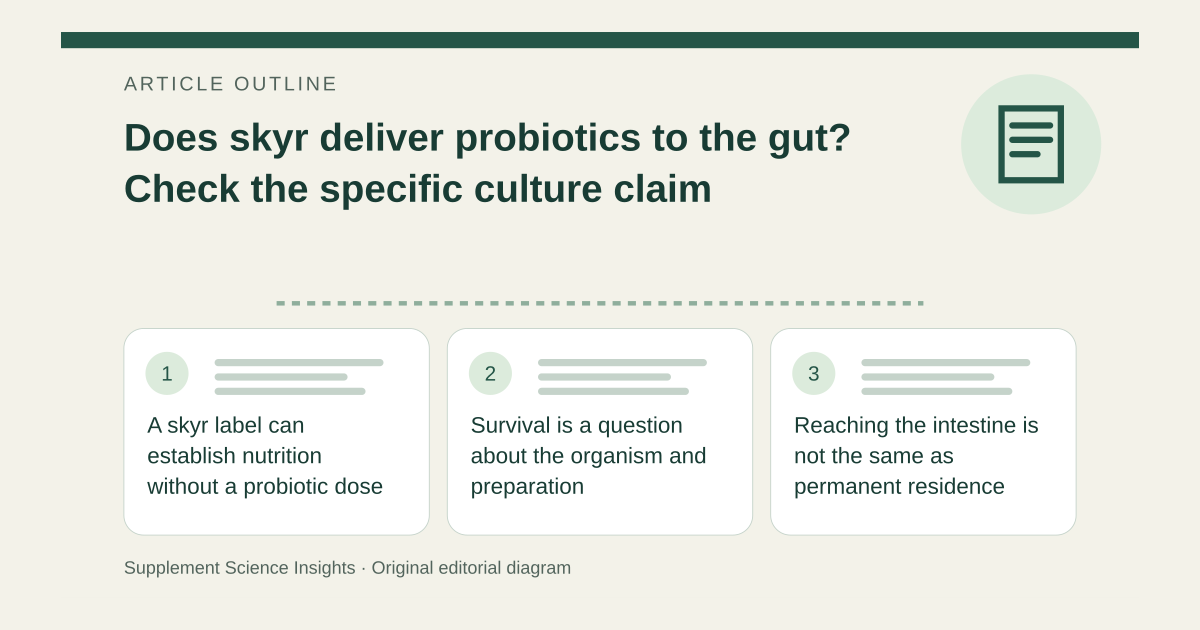
A skyr label can establish nutrition without a probiotic dose
The inspected Arla UK Natural 1 kg product lists skimmed-milk skyr, milk as an allergen and 10 grams of protein per 100 grams. It requires refrigeration. That page does not declare a strain-specific probiotic dose or quantify how many organisms reach the gut. This example is not a claim about all skyr brands. [1]
Survival is a question about the organism and preparation
NIH emphasizes the identity, strain and viable amount of a probiotic. Thickness, sourness and protein content cannot establish survival through digestion or a clinical benefit. A live-culture statement gives different information from a study of the same finished product for a defined outcome. [2]
Reaching the intestine is not the same as permanent residence
ISAPP explains that many probiotic organisms have temporary persistence and may act without permanently colonizing. That general principle does not prove that every skyr culture survives or provides the same benefit. It prevents an unsupported leap from survival to permanent gut repair. [3]
Compare the food and health claim separately
Imagine choosing a 150-gram serving of the inspected plain skyr: its declared protein scales to 15 grams. That arithmetic says nothing about CFUs. For a specific digestive goal, ask for the named culture, viable amount and relevant clinical evidence. [1][2]
| Information | What it can establish |
|---|---|
| 10 g protein per 100 g | Protein in a measured portion |
| Refrigeration instruction | Required handling |
| No strain or CFU declaration | Probiotic dose remains unestablished |
Sources for this article
- Arla Skyr 1kg | Icelandic Yogurt | Arla UK
Source consulted: 2026-09-21. This is a reference resource, not a claim that we conducted the studies or tested a product. - Probiotics - Health Professional Fact Sheet
Source consulted: 2026-09-21. This is a reference resource, not a claim that we conducted the studies or tested a product. - Is probiotic colonization essential? - International Scientific Association for Probiotics and Prebiotics (ISAPP)
Source consulted: 2026-09-21. This is a reference resource, not a claim that we conducted the studies or tested a product.