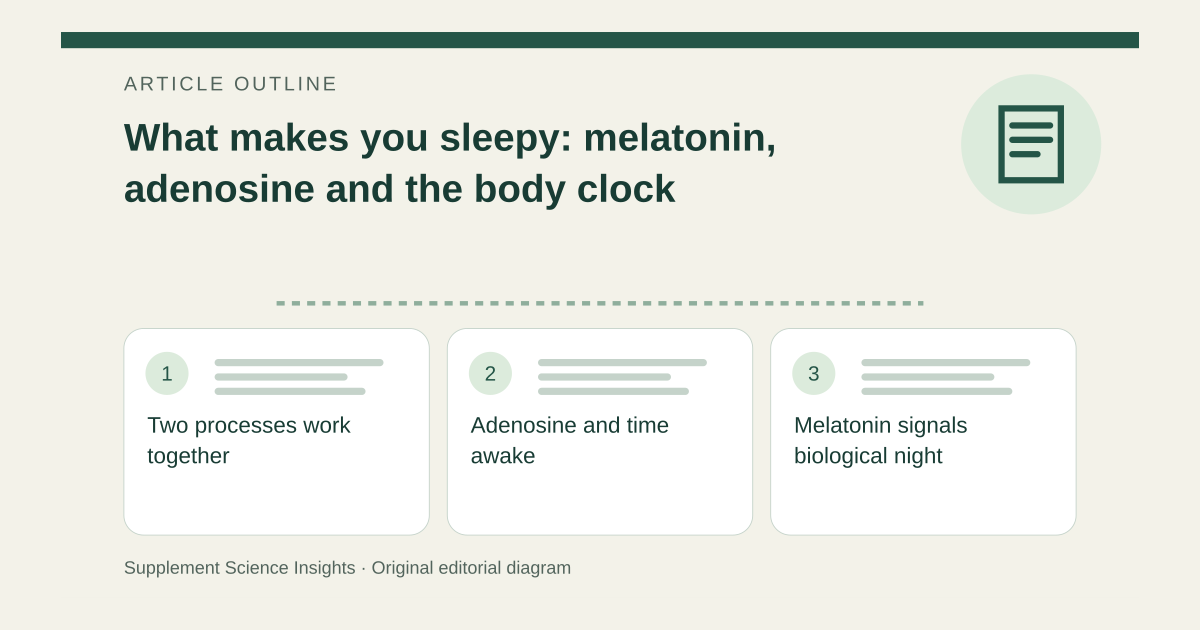
Two processes work together
NHLBI describes two interacting influences on sleep: a pressure to sleep that builds while a person is awake, and the timing system of the internal body clock. These can align or pull in different directions. A person can have been awake a long time while still receiving a strong circadian signal for alertness. [1]
This is why a single-hormone explanation is incomplete. Sleepiness is a state produced by interacting systems, not simply a meter showing how much melatonin is in the blood. [1]
Adenosine and time awake
Adenosine is one factor associated with the accumulating pressure to sleep. Its level in the brain rises during wakefulness and falls during sleep. It is a signaling compound, but it is not ordinarily classified as a sleep hormone in the same way as melatonin. [1]
The distinction is useful because the phrase sleepy hormones can combine several different kinds of molecules. Understanding their roles is more informative than placing them all into one interchangeable category. [1]
Melatonin signals biological night
Darkness supports the body's evening melatonin signal, helping prepare for sleep. Light received through the eyes helps synchronize the body clock, and bright artificial light late in the evening can disrupt the normal timing signal. [1]
Cortisol also follows a daily rhythm and helps prepare the body for waking. It should not be reduced to a substance that is always harmful or simply the opposite of melatonin. Timing and physiological context matter. [1]
Why this does not specify a supplement dose
An explanation of naturally produced melatonin does not establish that everyone with poor sleep needs a melatonin supplement. NCCIH describes different evidence and safety considerations for supplemental use. A persistent sleep problem can involve factors beyond a low or late hormone signal. [2][1]
The body-clock model is useful for understanding timing, but it does not diagnose a sleep disorder or identify a dose from symptoms alone. [2][1]
A hypothetical late evening
Imagine someone who has stayed awake longer than usual while sitting in bright light. Their sleep pressure may be high, while the light is influencing their timing signal. The two-process explanation accounts for that combination more accurately than assuming one sleepy hormone must be absent. [1]
| Signal or process | Role |
|---|---|
| Time awake and adenosine | Part of accumulating sleep pressure |
| Melatonin rhythm | A signal associated with biological night |
| Light cues | Help synchronize the internal clock |
Sources for this article
- Sleep Deprivation and Deficiency - What Makes You Sleep? | NHLBI, NIH
Source consulted: 2026-09-20. This is a reference resource, not a claim that we conducted the studies or tested a product. - Melatonin: What You Need To Know | NCCIH
Source consulted: 2026-09-20. This is a reference resource, not a claim that we conducted the studies or tested a product.