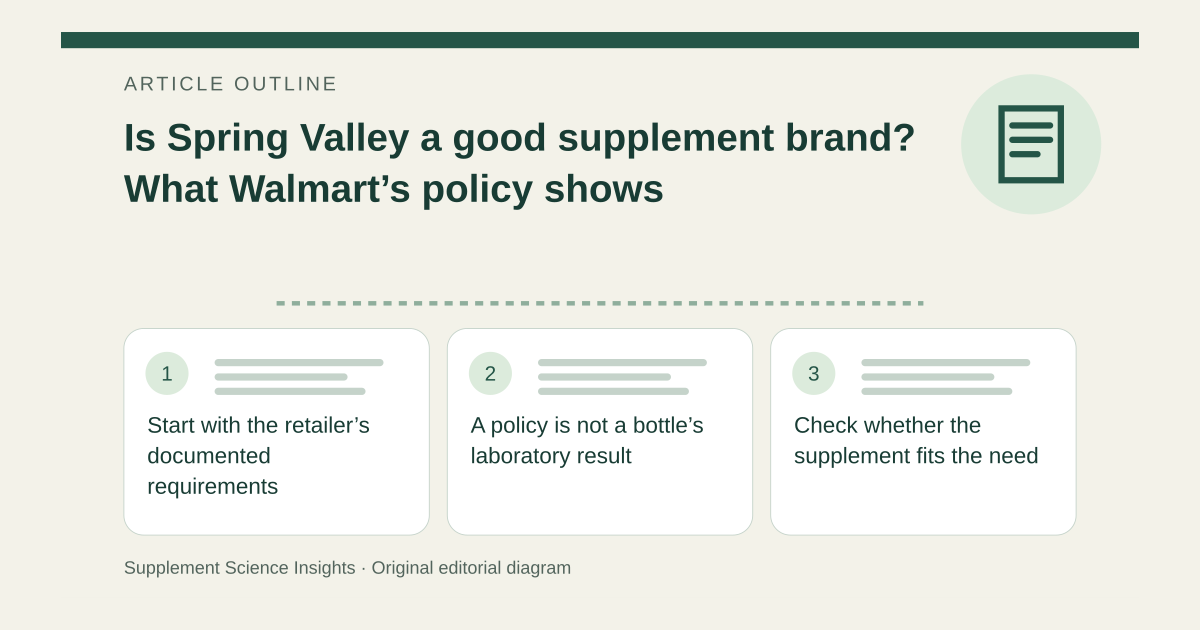
Start with the retailer’s documented requirements
Walmart’s Health and Wellness Product Safety Requirements identifies Spring Valley as an exclusively licensed private brand. For private-brand dietary supplement suppliers, it calls for full third-party cGMP audit reports for manufacturing facilities, with annual updates. This provides more specific context than assuming a store brand has no quality requirements. [1]
A policy is not a bottle’s laboratory result
The document specifies what suppliers must provide. It does not supply a current independent analysis of the particular Spring Valley bottle you are considering. Ask for product-specific information if purity, potency or a certification claim is central to the decision. [1][2]
Check whether the supplement fits the need
Review the nutrient or botanical, amount per serving, ingredient form and warnings. A lower price or a familiar retailer does not establish either poor quality or clinical usefulness. The intended benefit needs its own evidence, separate from manufacturing compliance. [2]
Compare equivalent servings
Imagine two products list the same ingredient but require different tablet counts. Compare the daily amount and cost for equivalent servings, then assess the formula and any verified testing claim. A front-label milligram number alone can make the comparison misleading. [2]
| Claim | What it establishes |
|---|---|
| Private-brand audit requirement | Documented supplier obligation |
| Specific product result | Requires product-specific evidence |
| Value comparison | Use equivalent servings and ingredient amounts |
Sources for this article
- Walmart: Health and Wellness Product Safety Requirements
Source consulted: 2026-09-20. This is a reference resource, not a claim that we conducted the studies or tested a product. - Dietary Supplements: What You Need to Know
Source consulted: 2026-09-20. This is a reference resource, not a claim that we conducted the studies or tested a product.