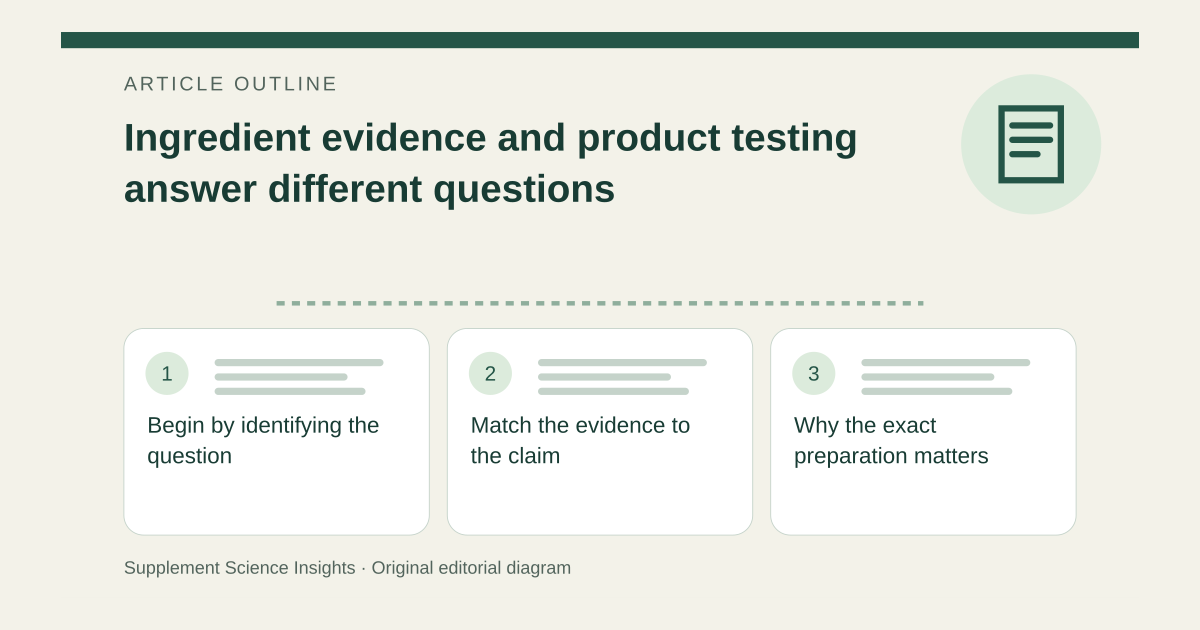
Begin by identifying the question
“Has evidence” can mean several different things. A material may have been identified in a laboratory, a batch may have passed specified quality tests, or a preparation may have been studied for a health outcome. Before weighing evidence, ask which of these questions the claim is trying to answer.
Our editorial approach is to keep those questions separate. A finding can be relevant and still be insufficient for the conclusion printed beside it. The table is a reading aid, not a rating system.
Match the evidence to the claim
Suppose a fictional bottle links to an ingredient study and a laboratory report. The useful task is to match each document to the precise claim being made. A report answering an identity question should not be presented as though it measured symptom improvement.
Write down the material, product or batch named in each document. If the report concerns a different preparation, record the mismatch. If the material cannot be identified, leave the connection unresolved rather than assuming the brand name is enough.
| Evidence | Question it can address | Question it does not answer by itself |
|---|---|---|
| Identity assay | What material was tested? | Does taking it improve a health outcome? |
| Specified contaminant test | Did this sample meet the tested limits? | Is every possible hazard absent? |
| Outcome trial | What happened under these study conditions? | Does every retail batch match the study material? |
Why the exact preparation matters
NIH’s research guidance emphasizes identity, purity, strength, composition and stability when characterizing supplement study materials. These details help make research reproducible and comparable. Botanical preparations and multi-ingredient products can require more description than a familiar ingredient name. [1]
The editorial implication is a transferability question: how closely does the retail preparation match the one that was studied? Record relevant differences in form, dose, formulation and population. A difference does not prove a product cannot work; it limits what that particular study can establish about it. [1]
Read the scope of a verification program
USP describes its Verified Mark in terms of label ingredients and amounts, specified contaminants, breakdown of the product and manufacturing practices. Those are useful quality checks. They are not the same as an outcome trial in people with a particular health concern. [2]
A verification provider’s description establishes what its program says it checks. It does not establish that a particular bottle qualifies. Confirm the exact product in the provider’s current records before attributing a mark to it; do not infer certification from the manufacturer’s other products. [2]
Read clinical evidence on its own terms
For a clinical claim, identify the preparation tested, participants, comparator, duration and outcome. Then assess how the study was conducted and what the result actually shows. A laboratory specification and a human outcome are not interchangeable endpoints. [3][1]
Avoid the reverse mistake, too: a trial of an ingredient does not establish the identity or contaminant profile of every retail batch containing its name. Treat the clinical and quality questions as separate entries in the same dossier. [3][1]
Use a short evidence record instead of a score
A practical record has four lines: the exact claim; the document that addresses it; the product or preparation the document concerns; and the remaining uncertainty. Attach the document date and link so another reader can check the interpretation.
This approach can end with an unresolved question. “No matching batch report located” is different from “the batch failed,” and “no matching outcome trial located” is different from “the product has been proved ineffective.” Keep those distinctions visible.
No product tested by this site, certification finding or efficacy ranking is implied by this guide. Named programs are discussed to explain evidence types, not to endorse a product.
Sources for this article
- NIH ODS — Product Integrity Guidance
Source consulted: 2026-09-17. This is a reference resource, not a claim that we conducted the studies or tested a product. - USP — What the USP Verified Mark Indicates
Source consulted: 2026-09-17. This is a reference resource, not a claim that we conducted the studies or tested a product. - Hopewell et al. — CONSORT 2025 statement, BMJ 389:e081123
Source consulted: 2026-09-17. This is a reference resource, not a claim that we conducted the studies or tested a product.