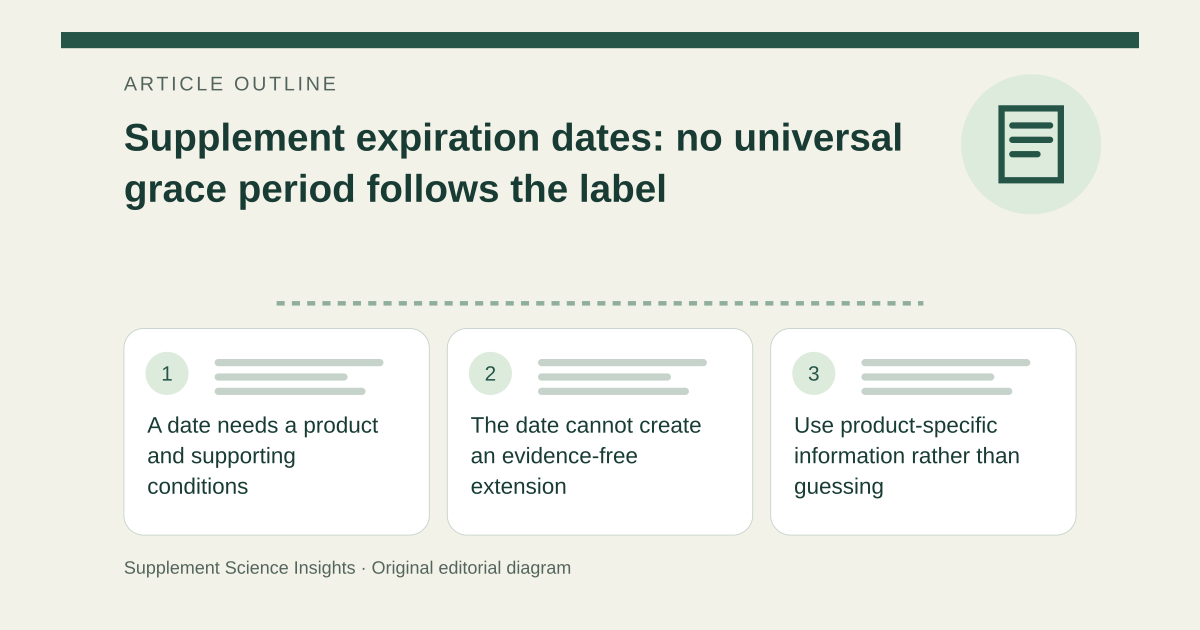
A date needs a product and supporting conditions
The FDA guide explains that supplement expiration dates are voluntary and should be supported by valid data when used. The statement concerns substantiation of a label claim; it is not a promise that every supplement has the same shelf life. [1][2]
A manufacturing date and an expiration date also answer different questions. If the code is unclear, ask the manufacturer what it means and what storage or opening conditions apply. [1][2]
The date cannot create an evidence-free extension
The cited guidance supplies no universal number of months after expiration during which potency or suitability is assured. It also does not show that a product becomes dangerous precisely at midnight on that date. Both claims would exceed the information provided. [1][2]
Product type, packaging and the manufacturer’s stability evidence matter. A general statement about dry vitamins should not be borrowed to clear a different liquid, oil or live-microorganism preparation. [1][2]
Use product-specific information rather than guessing
Contact the manufacturer with the exact product, lot and date if continued use is being considered. If the product is being used to meet a defined clinical need, discuss replacement with the treating professional instead of assuming the labeled amount is still dependable. [1][2]
Do not increase the serving to compensate for imagined potency loss. Without a reliable measurement, that creates another unverified exposure rather than solving the uncertainty. [1][2]
Two dates do not establish two identical stability profiles
Imagine two different supplements share an expiration month. That coincidence does not mean their ingredients, packaging or stability data are the same. One product’s information cannot establish a grace period for the other.
| Information | Interpretation |
|---|---|
| Printed date | Product-specific claim |
| Past-date potency | Not established by a general rule |
| Larger serving | Not a valid correction for uncertainty |
Sources for this article
- FDA: Dietary Supplement Labeling Guide, Chapter I
Source consulted: 2026-09-17. This is a reference resource, not a claim that we conducted the studies or tested a product. - FDA: Questions and Answers on Dietary Supplements
Source consulted: 2026-09-17. This is a reference resource, not a claim that we conducted the studies or tested a product.