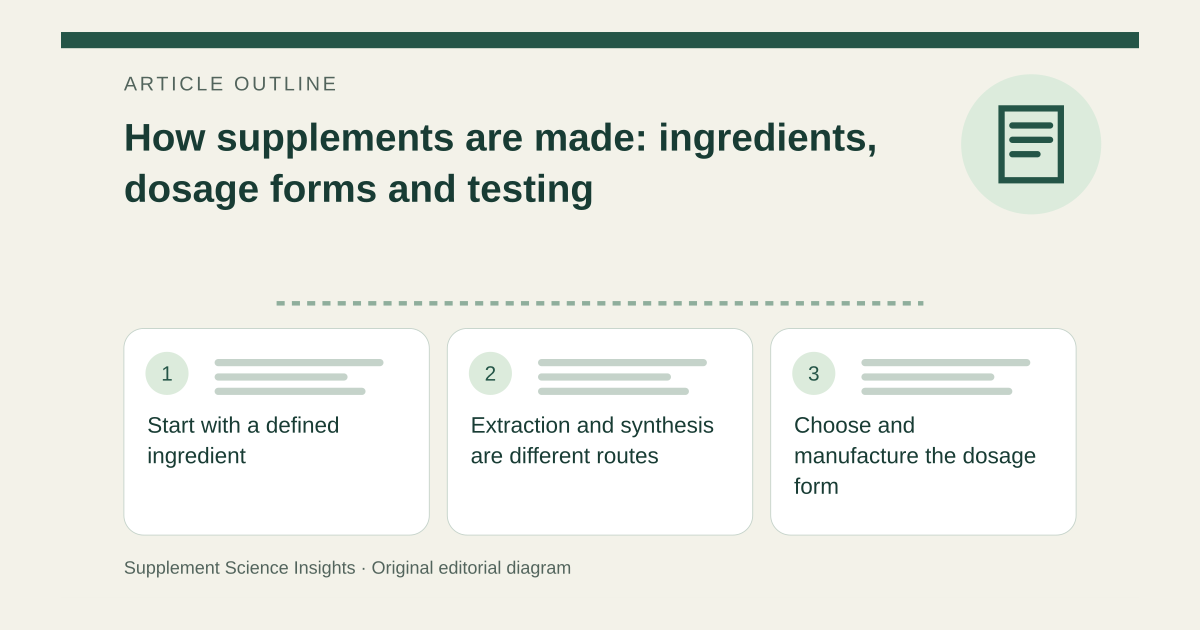
Start with a defined ingredient
Making a supplement begins with deciding what material the product will contain. A botanical extract, a purified vitamin, a mineral salt and a protein isolate need different sourcing and processing methods. The ingredient name should identify the material clearly enough to connect its specification with the intended formulation. [1]
An identity check asks whether the material is the intended ingredient. A purity check asks what else is present. Neither alone establishes that the ingredient will improve a health outcome. Keeping those questions separate matters because a precisely manufactured product can still have limited evidence for a proposed use. [1]
Extraction and synthesis are different routes
Some ingredients are separated from food or plant material. A documented pea-isolate process, for example, removes much of the starch and fiber before drying the protein-rich material. Other ingredients can be produced through chemical synthesis. The EMA's Circadin assessment describes synthesized melatonin followed by purification and ingredient testing. [2][3]
The origin is part of the specification, but it is not a complete quality ranking. Extraction can change the original food's composition substantially, and synthesis can produce a defined molecule. Neither “natural” nor “synthetic” tells you the actual contaminant results or the clinical evidence for a retail batch. [2][3]
Choose and manufacture the dosage form
A powder blend, capsule, tablet and liquid have different manufacturing requirements. For tablets, a documented pharmaceutical example uses milling, blending, granulation and compression. Other ingredients help provide bulk, handling properties or a desired release profile. [3][2]
The amount of active ingredient is not necessarily the total weight of a tablet or scoop. A flavored protein blend, for instance, contains ingredients besides protein. Manufacturing needs to distribute the intended components consistently rather than merely achieve a target total package weight. [3][2]
Check the finished product
NIH explains that supplement good manufacturing practices address identity, purity, strength and composition. Testing can help detect wrong ingredients, incorrect amounts, contaminants or packaging problems. Depending on the dosage form, checks can also include how a tablet breaks down or releases its ingredient. [1][3]
A finished-product result is more informative than a generic statement that a supplier tests raw materials. It should identify the tested product, lot, methods and scope. Independent quality seals can provide useful evidence about the checks they cover, but NIH cautions that such seals do not guarantee safety or effectiveness. [1][3]
Keep efficacy separate from production quality
The final step for a reader is to connect the actual product with the evidence relevant to its intended use. A study of a different extract, release form or ingredient combination may not apply. Manufacturing consistency makes a comparison more interpretable; it cannot fill a missing clinical evidence gap. [1]
Dietary supplements are also not approved by FDA for effectiveness before marketing in the way drugs are. A facility inspection, a supplier document or a quality logo should not be described as FDA approval of the supplement's benefits. [1]
Following a hypothetical product dossier
Suppose a company supplies a raw-material identity report and a finished-lot assay. Those support two particular quality questions. If the advertised benefit comes from a study of another formulation, that remains an unresolved evidence question even when both quality reports pass. [1]
| Record | What it supports |
|---|---|
| Ingredient identity test | The sampled material matches the intended identity |
| Finished-lot assay | Measured content within the reported test scope |
| Relevant clinical study | An outcome in a specified population and formulation |
Sources for this article
- Dietary Supplements: What You Need to Know - Consumer
Source consulted: 2026-09-20. This is a reference resource, not a claim that we conducted the studies or tested a product. - GRAS Notice 851, Pea protein
Source consulted: 2026-09-20. This is a reference resource, not a claim that we conducted the studies or tested a product. - Circadin, INN-melatonin
Source consulted: 2026-09-20. This is a reference resource, not a claim that we conducted the studies or tested a product.