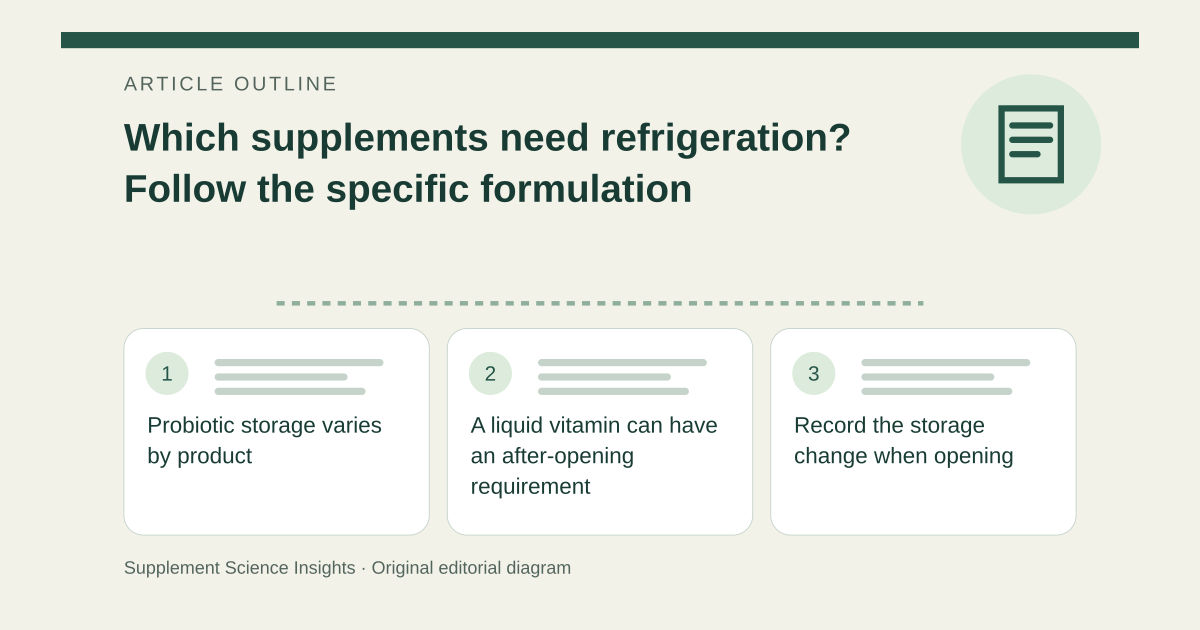
Probiotic storage varies by product
ODS directs consumers to the product’s storage conditions because some probiotics need refrigeration and others do not. Viable counts through the expiration date are more useful than a count at manufacture. A refrigerator requirement is a stability instruction, not proof that the product is more effective. [1]
A liquid vitamin can have an after-opening requirement
The inspected NaturesPlus Liquid Sunshine D3 page instructs refrigeration after opening. This is one concrete example, not a rule for every liquid D formulation. Oils, water-based liquids and dry tablets can have different packaging and stability needs. [2]
Record the storage change when opening
Imagine one bottle says cool and dry while another says refrigerate after opening. Follow each instruction and note when the second bottle was opened. If a product has spent time outside its specified conditions, ask the manufacturer about that exact duration and temperature rather than assuming cooling it later restores potency. [1][2]
| Evidence | What it can establish |
|---|---|
| Room-temperature label | Use the stated conditions |
| Refrigerate after opening | The requirement changes when opened |
| Temperature excursion | Needs product-specific advice |
Sources for this article
- Probiotics - Health Professional Fact Sheet
Source consulted: 2026-09-20. This is a reference resource, not a claim that we conducted the studies or tested a product. - Liquid Sunshine Vitamin D3
Source consulted: 2026-09-20. This is a reference resource, not a claim that we conducted the studies or tested a product.