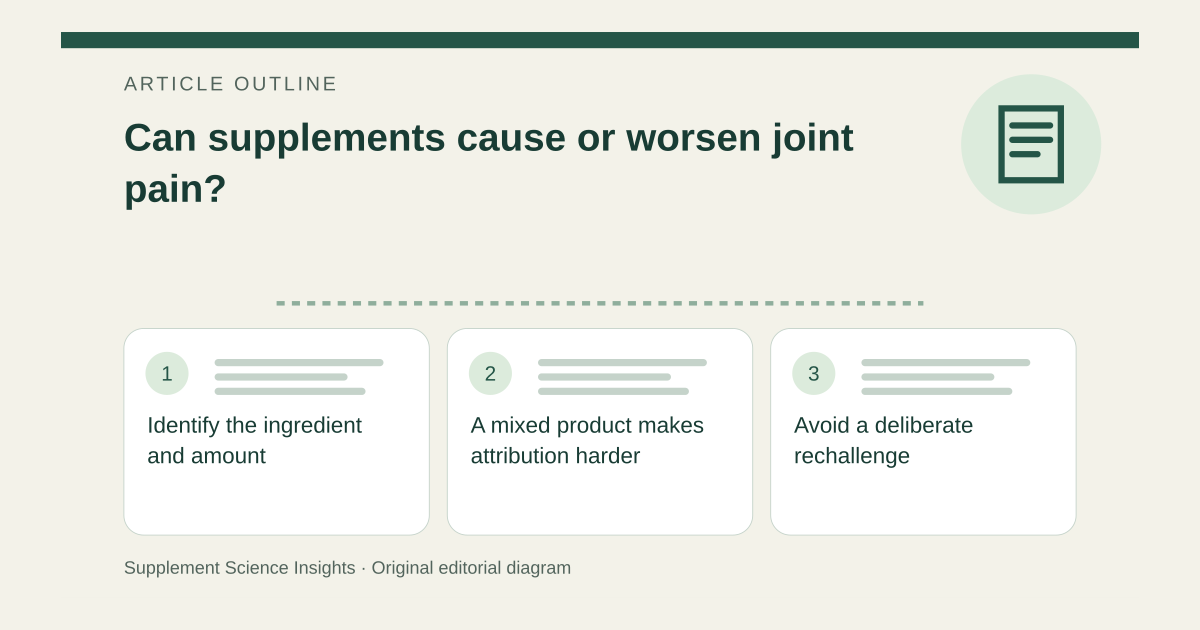
Identify the ingredient and amount
ODS discusses acute gout among reasons to stop high-dose nicotinic acid used for lipid management under clinical supervision. This is not a claim that ordinary food-level niacin causes arthritis or that all vitamin B3 forms have identical risks. The exact form, dose and medical history are essential. [1]
A mixed product makes attribution harder
Record when a new supplement began, serving changes and all other medicines. Several products may contain the same ingredient. Quality or composition problems can also complicate an apparent reaction, so retain the packaging and lot details. Do not assume that a product sold for joints cannot cause an adverse effect. [2][3]
Avoid a deliberate rechallenge
Imagine a painful flare follows a new high-dose supplement. Discuss stopping the nonessential product and evaluating the symptoms with a clinician; do not take another dose simply to test the theory. A hot swollen joint, fever or inability to use the joint warrants prompt assessment rather than a different joint-support formula. [2][1]
| Situation | Appropriate distinction |
|---|---|
| A symptom | Identify its cause |
| A marketing promise | Check the measured outcome |
| A treatment change | Review suitability and follow-up |
Sources for this article
- Niacin - Health Professional Fact Sheet
Source consulted: 2026-09-21. This is a reference resource, not a claim that we conducted the studies or tested a product. - Dietary Supplements: What You Need to Know - Consumer
Source consulted: 2026-09-21. This is a reference resource, not a claim that we conducted the studies or tested a product. - Questions and Answers on Dietary Supplements | FDA
Source consulted: 2026-09-21. This is a reference resource, not a claim that we conducted the studies or tested a product.