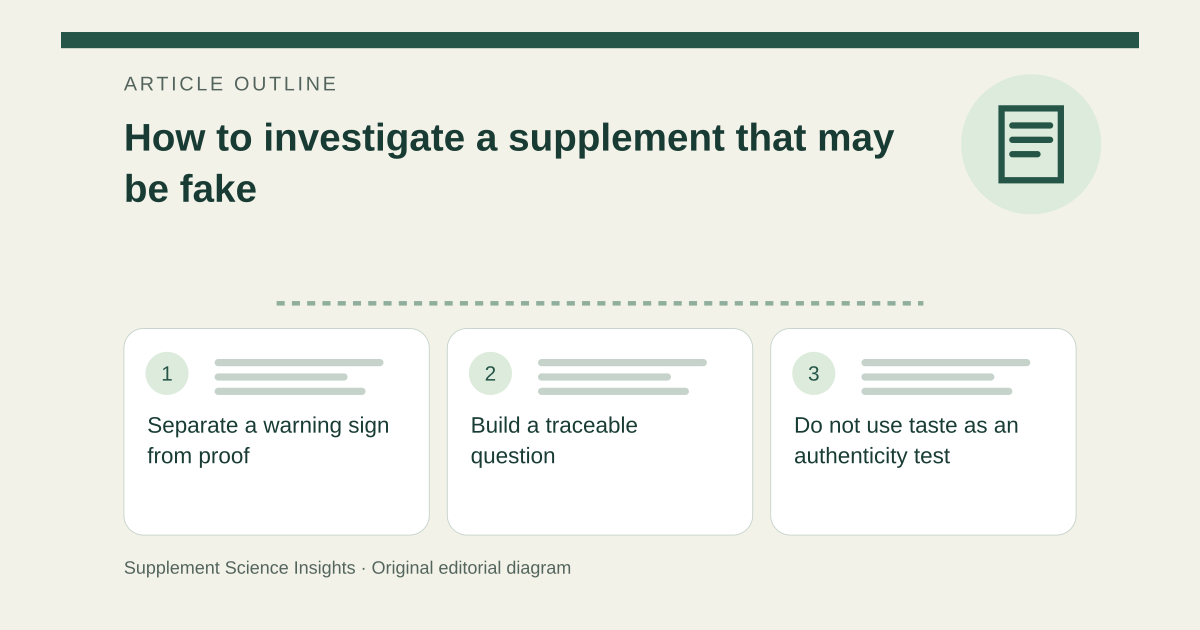
Separate a warning sign from proof
An unfamiliar label, an unusually low price or a spelling error can prompt questions; none is a laboratory identification of the contents. Conversely, a convincing label does not establish ingredient identity or purity. FDA’s quality framework addresses what the product actually contains, which cannot be fully assessed from a photograph. [1]
Build a traceable question
Compare the received label with the manufacturer’s current information and contact the manufacturer using independently located contact details. Provide the lot, seller and photographs where available. Ask whether the packaging and lot details match their records. This is a practical verification step, not a guarantee that a copied lot number proves authenticity. [1]
Do not use taste as an authenticity test
Imagine two bottles look different but have the same name. A legitimate packaging change is possible, as is a problem; the visual difference alone cannot decide. Keep the purchase record and request clarification rather than consuming the product to test its taste or effects. A quality seal also needs to match the actual product and certifier’s scope. [2]
| Example | Interpretation |
|---|---|
| Packaging discrepancy | Reason to investigate |
| Manufacturer lot response | Traceability information |
| Taste or perceived effect | Not an authentication method |
Sources for this article
- Questions and Answers on Dietary Supplements | FDA
Source consulted: 2026-09-20. This is a reference resource, not a claim that we conducted the studies or tested a product. - Dietary Supplements: What You Need to Know
Source consulted: 2026-09-20. This is a reference resource, not a claim that we conducted the studies or tested a product.