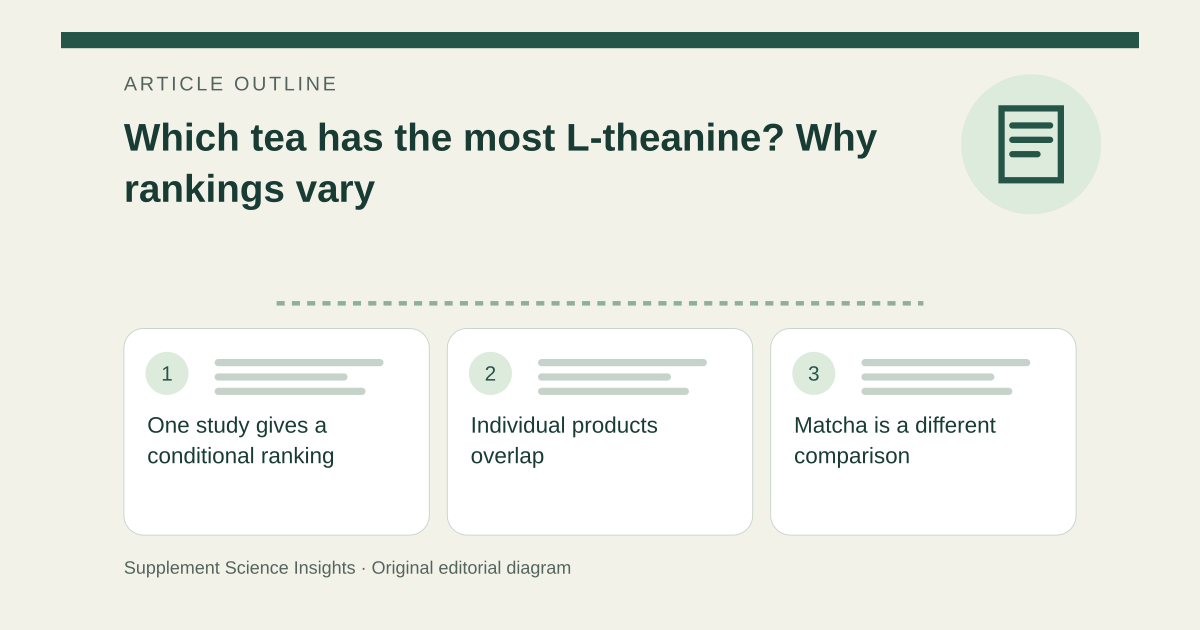
One study gives a conditional ranking
A study of commercial teas reported mean extracted theanine amounts of 6.56 mg/g for green, 6.26 for white, 6.09 for oolong and 5.13 for black tea. The researchers used one gram of tea in 100 mL water at 80°C for three minutes. These are results under that method, not universal cup values. [1]
Individual products overlap
The authors emphasized variation within tea categories and concluded that theanine content alone was not a good way to distinguish tea types. A particular black tea can therefore contain more than a particular green tea even when the group means rank differently. [1]
Matcha is a different comparison
When matcha powder is consumed, the powder mass is relevant rather than only the liquid extracted from leaves. A separate analysis found wide variation across selected matcha samples. Comparing milligrams per gram of powder with milligrams per brewed cup without conversion is misleading. [2]
Use a measured product amount for precision
Imagine two packages advertise high theanine but provide no assay or serving data. Their tea-type names cannot establish which serving contains more. Choose by preference unless a reliable product-specific analysis is available, and account for caffeine separately. [1][3]
| Label detail | What it tells you |
|---|---|
| Green or black | Category, not an exact dose |
| Milligrams per gram | Requires serving mass |
| Milligrams per cup | Requires brewing conditions |
| Product assay | More specific than category ranking |
Sources for this article
- Theanine and Caffeine Content of Infusions Prepared from Commercial Tea Samples - PMC
Source consulted: 2026-09-21. This is a reference resource, not a claim that we conducted the studies or tested a product. - Variations of main quality components of matcha from different regions in the Chinese market - PMC
Source consulted: 2026-09-21. This is a reference resource, not a claim that we conducted the studies or tested a product. - Spilling the Beans: How Much Caffeine is Too Much? | FDA
Source consulted: 2026-09-21. This is a reference resource, not a claim that we conducted the studies or tested a product.