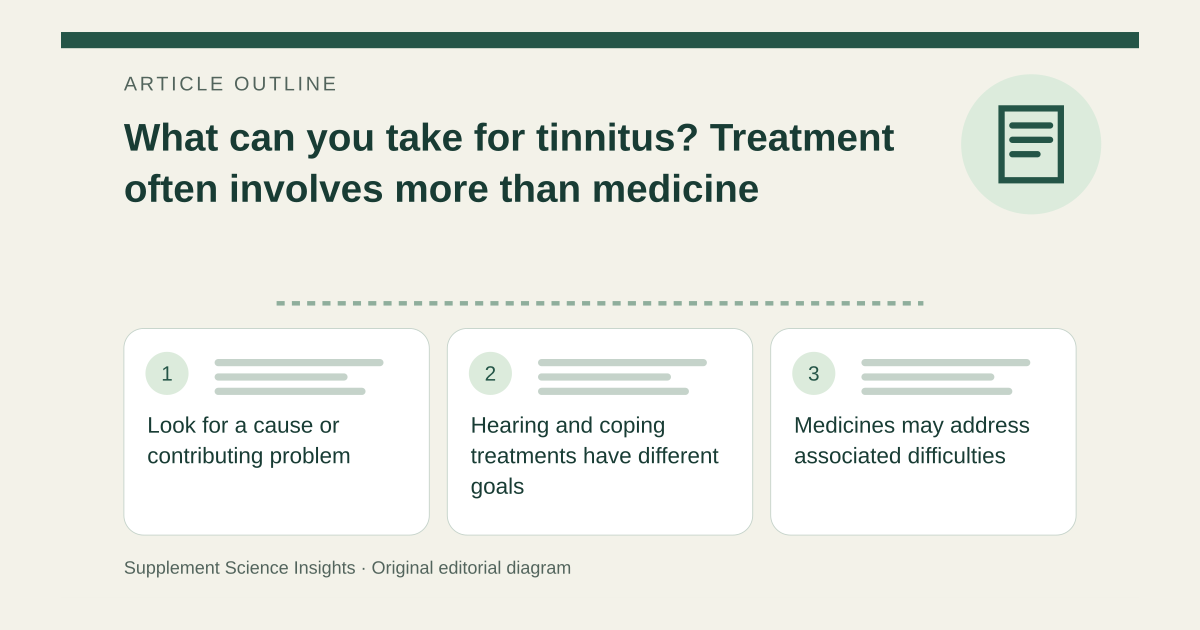
Look for a cause or contributing problem
A clinician can review hearing, ear symptoms and medicines. NIDCD notes that some drugs can be associated with tinnitus. Do not discontinue a needed prescription yourself; the timing, dose and alternatives require review. [1]
Hearing and coping treatments have different goals
Hearing aids may help when hearing loss is present. Sound therapy and behavioural approaches can reduce the impact of tinnitus on daily life. Improvement in distress or sleep is meaningful even if it does not mean the sound has disappeared. [1]
Medicines may address associated difficulties
NIDCD explains that medicines may be prescribed for anxiety, mood or sleep problems associated with tinnitus, rather than as a specific tinnitus cure. It also states that marketed vitamin and herbal cures have not been proved effective. [1]
Certain accompanying symptoms change the urgency
Tinnitus with sudden hearing loss, facial weakness or vertigo, or after a head injury, needs emergency assessment under NHS guidance. Do not wait for a supplement to work in these situations. [2]
Define the goal before choosing an intervention
Imagine ringing becomes most intrusive in a silent bedroom. An audiology assessment and a sound or sleep-management plan address that practical problem more directly than choosing a product by its ear-health label. Persistent or worsening symptoms deserve assessment. [1]
| Situation | Next consideration |
|---|---|
| Hearing loss | Audiology and hearing options |
| Distress or sleep disruption | Targeted management |
| Sudden hearing loss | Emergency assessment |
Sources for this article
- What Is Tinnitus? — Causes and Treatment | NIDCD
Source consulted: 2026-09-20. This is a reference resource, not a claim that we conducted the studies or tested a product. - Tinnitus - NHS
Source consulted: 2026-09-20. This is a reference resource, not a claim that we conducted the studies or tested a product.