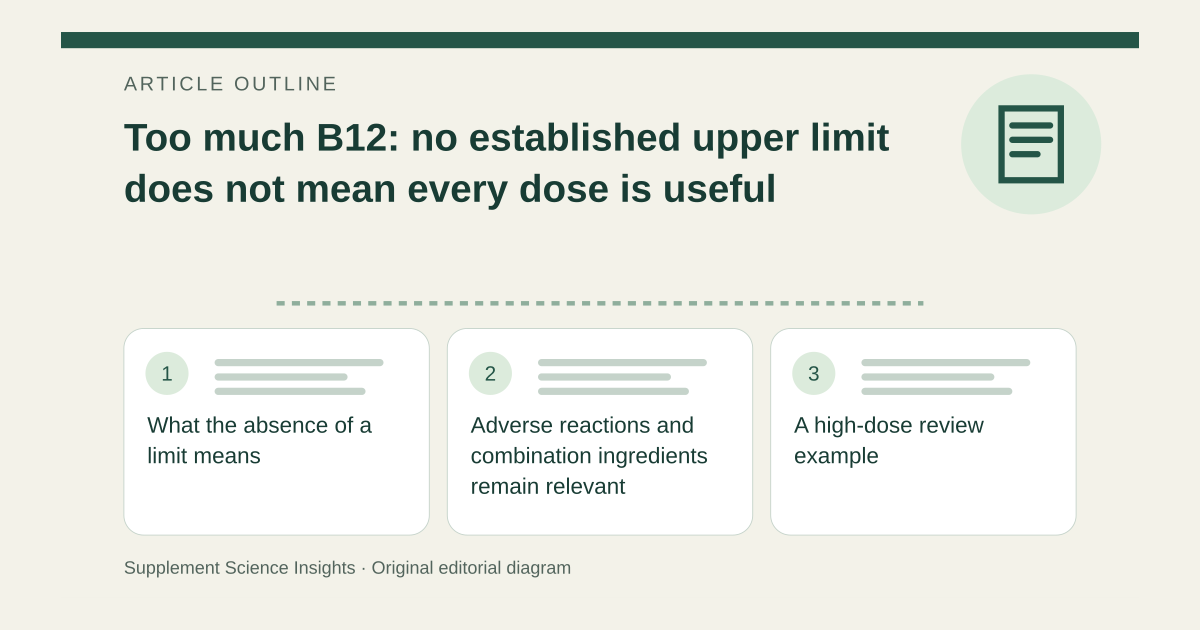
What the absence of a limit means
The Food and Nutrition Board did not set a tolerable upper intake level for B 12 because of its low potential for toxicity. This differs from a finding that any quantity produces additional benefit. The adult RDA of 2.4 mcg is a nutritional reference; deficiency treatment can use much larger doses for a different purpose. [1]
Adverse reactions and combination ingredients remain relevant
B 12 contains cobalt. MHRA describes sensitivity reactions in people with cobalt allergy, including reactions that can be delayed. A B-complex or multivitamin also contains other ingredients with their own risks. Calling a reaction B 12 toxicity without assessment can miss an allergy, another ingredient or an unrelated illness. [2][1]
A high-dose review example
Imagine someone takes a B 12 tablet plus a B-complex and notices a rash. Record both complete labels, doses and timing and obtain medical advice; serious allergic symptoms need urgent care. Do not assume that low B 12 toxicity rules out a reaction or that a higher dose is needed because the first product did not increase energy. [2][1]
| Hypothetical claim | What follows |
|---|---|
| No B 12 upper limit | Not proof that more is better |
| B-complex also taken | Assess every ingredient |
| Rash after a dose | Consider reaction and clinical assessment |
Sources for this article
- Vitamin B12 - Health Professional Fact Sheet
Source consulted: 2026-09-20. This is a reference resource, not a claim that we conducted the studies or tested a product. - Vitamin B12 (hydroxocobalamin, cyanocobalamin): advise patients with known cobalt allergy to be vigilant for sensitivity reactions - GOV.UK
Source consulted: 2026-09-20. This is a reference resource, not a claim that we conducted the studies or tested a product.