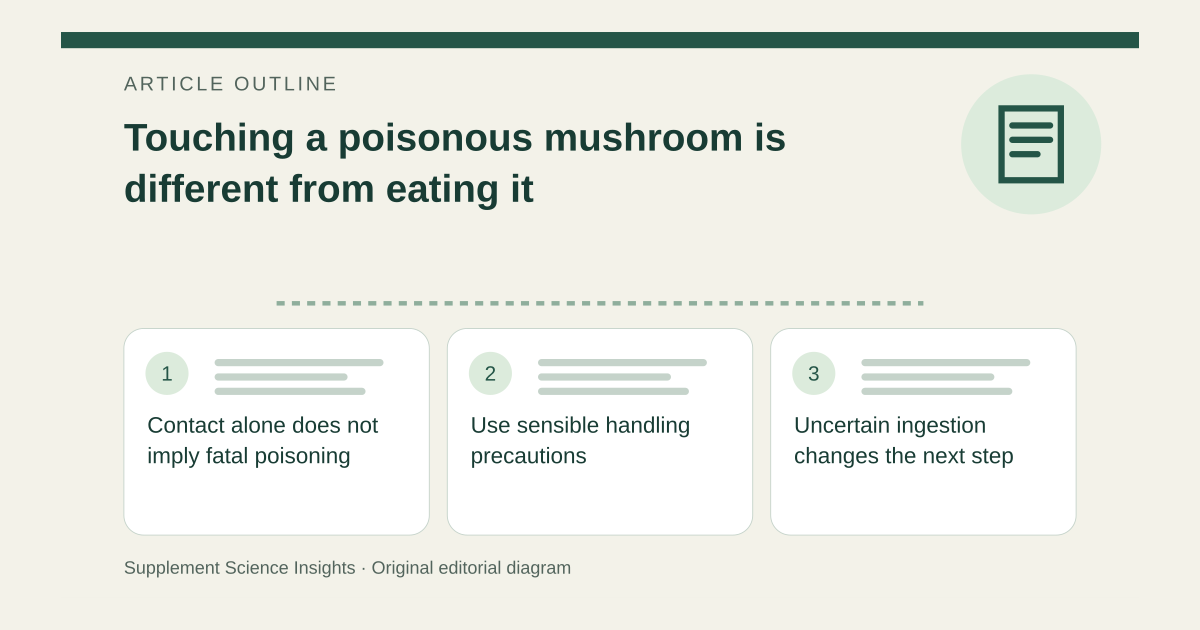
Contact alone does not imply fatal poisoning
California public-health guidance distinguishes touching from eating, and BCCDC states that touching death caps is not the ingestion hazard. This does not establish that every person is incapable of a skin reaction; it addresses the mistaken idea that merely touching a death cap necessarily causes systemic mushroom poisoning. [1][2]
Use sensible handling precautions
BCCDC recommends gloves for removal and washing hands afterward. Keep mushrooms away from food, children and pets. Do not interpret permission to handle a specimen as permission to taste it or as a way to identify an edible species. [2][3]
Uncertain ingestion changes the next step
If a child may have put pieces in the mouth, or someone ate an unknown mushroom, seek poison advice promptly rather than relying on contact reassurance. Save remaining material for identification and describe what may have happened. [3]
Distinguish two common scenarios
Imagine an adult briefly lifts a mushroom and then washes their hands, versus a toddler found chewing one. Those are different exposures. The second requires prompt poison-center assessment even if the toddler initially appears well. [2][3]
| Exposure | Appropriate distinction |
|---|---|
| Touched a specimen | Wash hands; not equivalent to eating |
| Possible mouth contact or ingestion | Seek poison advice |
| Serious symptoms | Emergency assessment |
Sources for this article
- Poisonous Wild Mushrooms | California Department of Public Health
Source consulted: 2026-09-21. This is a reference resource, not a claim that we conducted the studies or tested a product. - Be on the lookout for poisonous death cap mushrooms in southwestern B.C.
Source consulted: 2026-09-21. This is a reference resource, not a claim that we conducted the studies or tested a product. - Mushrooms
Source consulted: 2026-09-21. This is a reference resource, not a claim that we conducted the studies or tested a product.