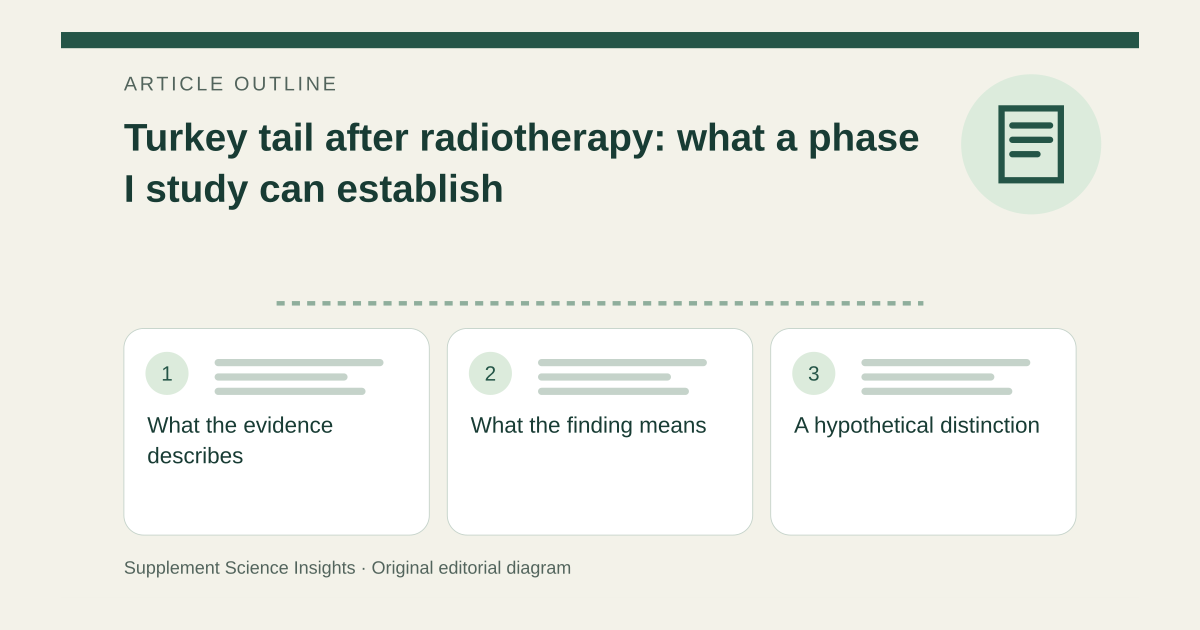
What the evidence describes
Eleven participants were recruited after breast-cancer radiotherapy, and nine completed six weeks of a Trametes versicolor preparation. Three participants received each of the studied daily amounts: 3, 6 or 9 grams. [1]
The investigators recorded adverse events and exploratory immune measurements. The tiny cohorts and absence of a placebo comparison limit causal conclusions about those measurements and uncommon harms. [1]
What the finding means
A tolerability signal is not proof of reduced recurrence or longer survival. This preparation also cannot be assumed equivalent to PSK or every retail product. NIH/NCCAM and Gateway for Cancer Research supported the study; conflicts were not established from the retrieved text. [1]
A hypothetical distinction
Imagine only three people receive the highest amount. Their experience cannot rule out an uncommon adverse effect.
| Detail | Interpretation |
|---|---|
| Finding | Preserve the measured or observed outcome |
| Context | Species, preparation or setting matters |
| Limit | No universal safety or benefit guarantee |
Sources for this article
- Phase 1 Clinical Trial of Trametes versicolor in Women with Breast Cancer - PMC
Source consulted: 2026-09-19. This is a reference resource, not a claim that we conducted the studies or tested a product.