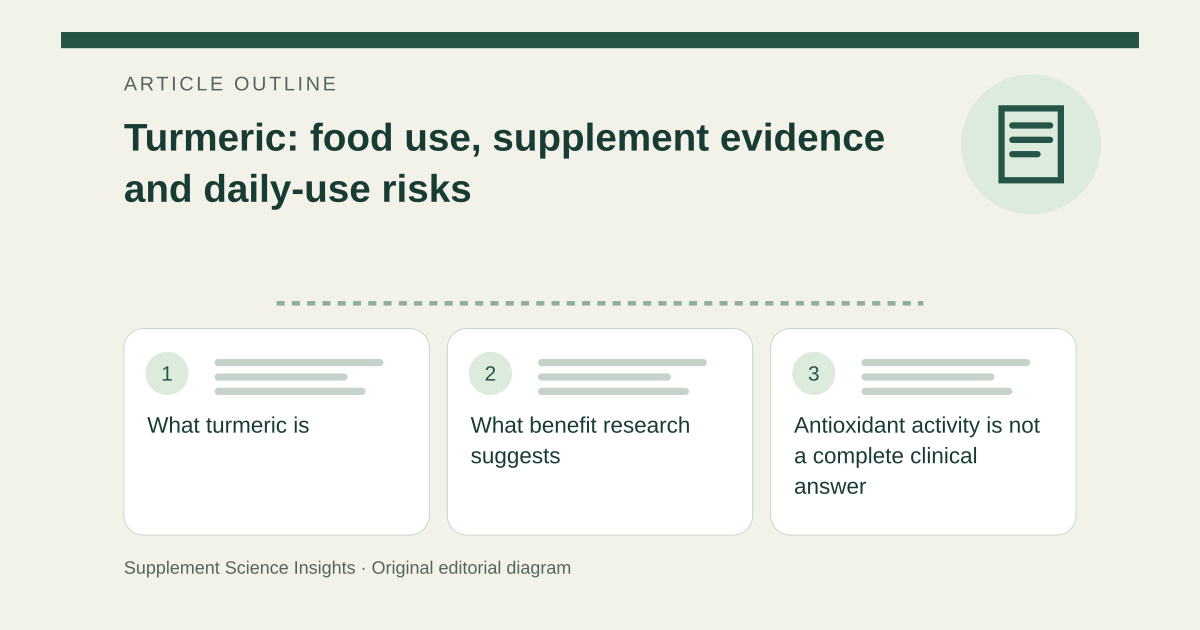
What turmeric is
Turmeric comes from the rhizome, or underground stem, of a plant in the ginger family. It is used as a spice and supplies a characteristic yellow color. Curcumin is one of its components, within a group called curcuminoids; turmeric is not simply another name for pure curcumin. [1]
A culinary portion of turmeric, a concentrated extract and a product designed to increase curcumin absorption can produce different exposures. The quantity of turmeric powder is not automatically the quantity of curcumin, so comparisons need the actual preparation and amount. [1]
What benefit research suggests
NCCIH reports that turmeric and curcumin have been studied for several conditions, including knee osteoarthritis, fatty liver disease and lipid disorders. Some initial findings are encouraging, particularly for certain osteoarthritis measures, but higher-quality evidence is needed for firm conclusions. [1]
The agency also highlights difficulty comparing products. They can differ in curcumin content and additional ingredients, including piperine used to improve absorption. A result from one formulation cannot be assigned to ordinary turmeric seasoning or every extract. [1]
Antioxidant activity is not a complete clinical answer
Curcuminoids are investigated for biological activities, but a mechanism or an antioxidant claim is not itself proof that daily turmeric prevents disease or improves a particular symptom. A meaningful clinical conclusion needs an outcome measured in people using a specified preparation. [1]
This distinction matters when a label moves from describing an ingredient's properties to promising broad protection. More absorption also does not automatically mean more benefit or a better risk-benefit balance. The formulation changes exposure, which can affect safety as well as the intended effect. [1]
What daily use can mean for safety
NCCIH distinguishes conventional oral preparations from enhanced-bioavailability products. Conventional turmeric or curcumin has been used with apparent short-term safety under studied conditions, but that does not establish indefinite daily safety for every product. Oral use can cause reflux, nausea, stomach upset, diarrhea or constipation. [1]
Liver injury has been reported with some highly bioavailable formulations. Symptoms such as dark urine or jaundice warrant stopping the supplement and seeking medical assessment. Supplement use during pregnancy may be unsafe, and safety beyond ordinary food amounts during breastfeeding is not well established. [1]
Food use is a different decision from supplementation
Using turmeric as a seasoning is not equivalent to starting a concentrated daily supplement. People taking medicines should discuss a proposed herbal supplement with a clinician or pharmacist because interactions can occur. Do not replace effective treatment with turmeric on the strength of an early study or a general wellness claim. [1]
This overview does not recommend a daily supplement dose. The unanswered question is not simply whether turmeric has any biological activity, but whether a specified product offers a meaningful benefit for a particular person with acceptable risk. [1]
A hypothetical study match
Imagine a trial tests a defined curcumin formulation with an absorption enhancer. A kitchen recipe containing turmeric powder is not an equivalent intervention. Keep the preparation, amount, duration and outcome together when deciding what the study can explain. [1]
| Preparation | What needs identifying |
|---|---|
| Turmeric spice | Amount of the whole food ingredient |
| Turmeric or curcumin extract | Composition and concentration |
| Enhanced-absorption product | Delivery system, other ingredients and safety evidence |
Sources for this article
- Turmeric: Usefulness and Safety | NCCIH
Source consulted: 2026-09-20. This is a reference resource, not a claim that we conducted the studies or tested a product.