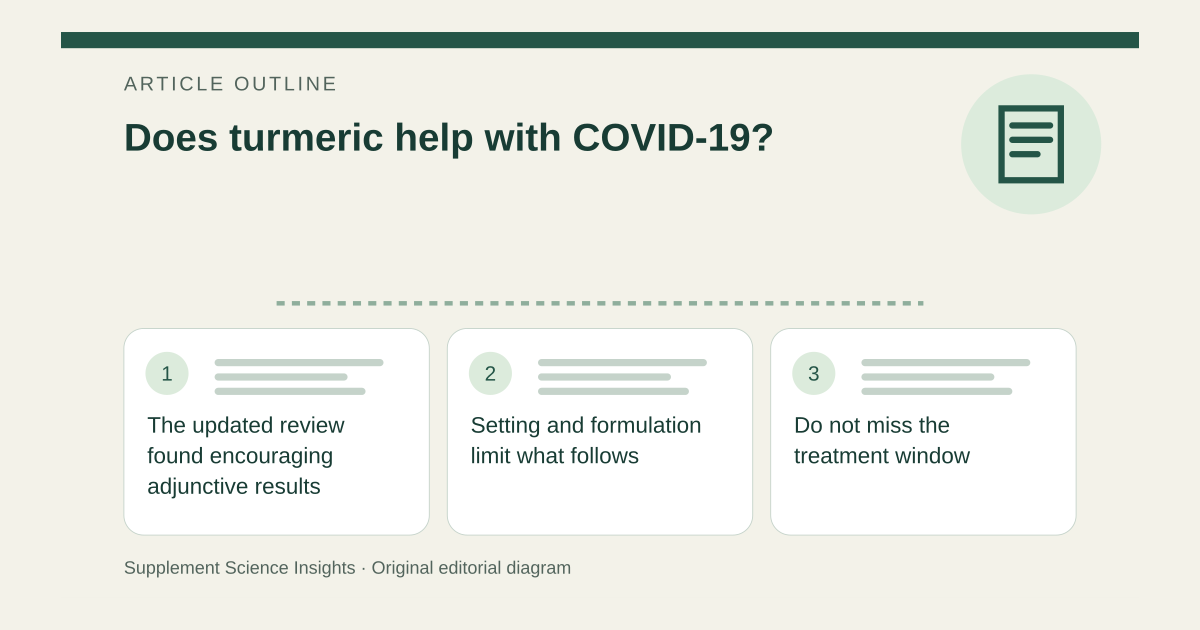
The updated review found encouraging adjunctive results
A 2025 systematic review abstract reports twenty-three randomized trials involving 1,407 participants. Pooled results favored turmeric-based interventions for several clinical outcomes, including mortality, and the review rated mortality evidence as moderate certainty. Nine trials were at high risk of bias, although the reported sensitivity analysis remained favorable after excluding high-risk studies. [1]
Setting and formulation limit what follows
Most studies enrolled hospitalized patients, and interventions were added to standard care. Enhanced curcumin products were common. These results do not establish that kitchen turmeric, tea or an arbitrary capsule prevents infection, replaces treatment or has the same effect in a vaccinated outpatient with a current infection. [1]
Do not miss the treatment window
CDC advises people at higher risk to contact a health professional promptly, even for mild symptoms. Eligible antiviral treatments must start within a short window, generally five to seven days depending on the medicine. Waiting to see whether a supplement works can mean missing that opportunity. [2]
Review combinations and adverse effects
Tell the clinician or pharmacist about all medicines and supplements, particularly when an antiviral is being considered. Mild gastrointestinal events in trials do not establish universal safety; NCCIH also reports liver injury with some enhanced turmeric products. The exact formulation and medical history matter. [2][3][1]
Adjunctive research does not support substitution
Imagine a study compares standard care plus curcumin with standard care plus placebo. A favorable result addresses the added intervention in that setting. It does not show that curcumin alone can replace the standard care received by both groups. [1]
| Study feature | Boundary |
|---|---|
| Added to standard care | Not replacement therapy |
| Mostly hospitalized participants | Not universal outpatient benefit |
| Defined enhanced preparation | Not every tea or capsule |
| Short antiviral window | Seek timely assessment |
Sources for this article
- Effectiveness and safety of turmeric for the treatment of COVID-19: An updated systematic review and meta-analysis of randomized controlled trials.
Source consulted: 2026-09-21. This is a reference resource, not a claim that we conducted the studies or tested a product. - Types of COVID-19 Treatment | Covid | CDC
Source consulted: 2026-09-21. This is a reference resource, not a claim that we conducted the studies or tested a product. - Turmeric: Usefulness and Safety | NCCIH
Source consulted: 2026-09-21. This is a reference resource, not a claim that we conducted the studies or tested a product.