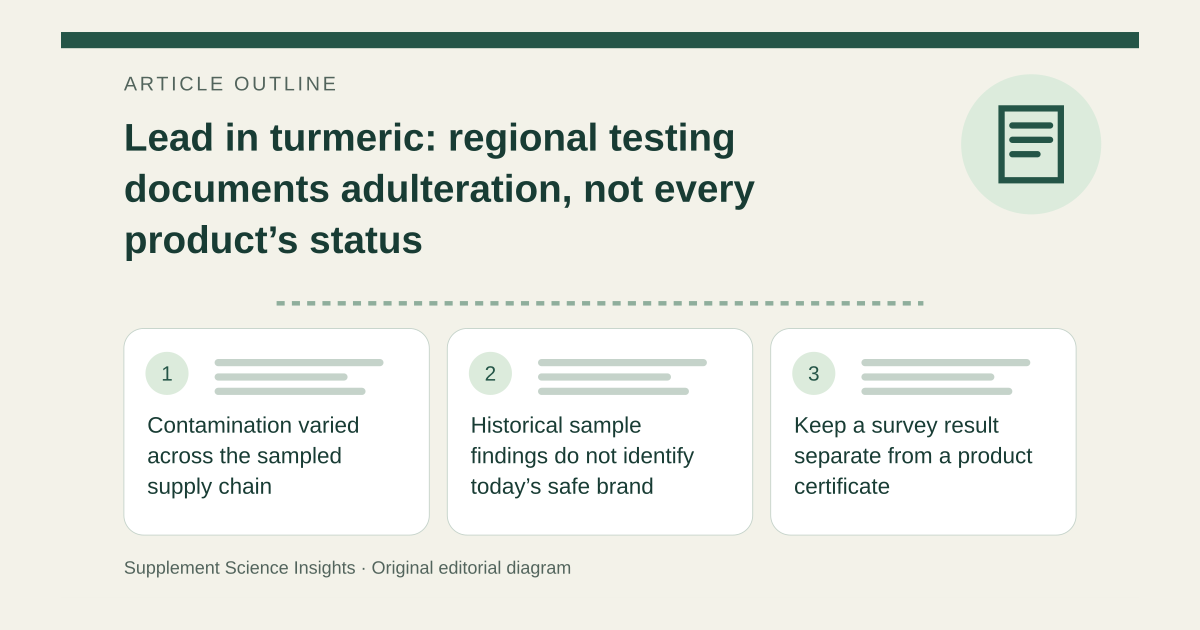
Contamination varied across the sampled supply chain
Researchers collected 356 turmeric samples from wholesale and retail bazaars in India, Pakistan, Sri Lanka and Nepal. The sampling occurred from December 2020 through March 2021 and included roots and powder. [1]
Fourteen percent had lead above the study’s 2 micrograms-per-gram detection threshold. Higher-level samples had lead-to-chromium patterns consistent with lead chromate adulteration. [1]
Historical sample findings do not identify today’s safe brand
Some samples had extremely high levels. The paper modeled possible child blood-lead exposure; it did not measure every purchaser’s blood lead. The authors declared no known competing interests; funding was not established from the abstract. [1]
The sample percentage is not a global prevalence estimate or a current batch certificate. Appearance, an organic claim or a country name cannot replace relevant contaminant-testing evidence. Product assessment needs evidence tied to the actual supply chain and lot rather than extrapolation from this survey alone. [1]
Keep a survey result separate from a product certificate
Imagine a survey finds contamination in some samples. A different untested package has not thereby passed or failed an analysis; its status remains unverified.
| Detail | Interpretation |
|---|---|
| 356 samples | Defined historical survey |
| Lead/chromium analysis | Evidence of adulteration |
| Current retail lot | Needs its own evidence |
Sources for this article
- Evidence of turmeric adulteration with lead chromate across South Asia - PubMed
Source consulted: 2026-09-19. This is a reference resource, not a claim that we conducted the studies or tested a product.