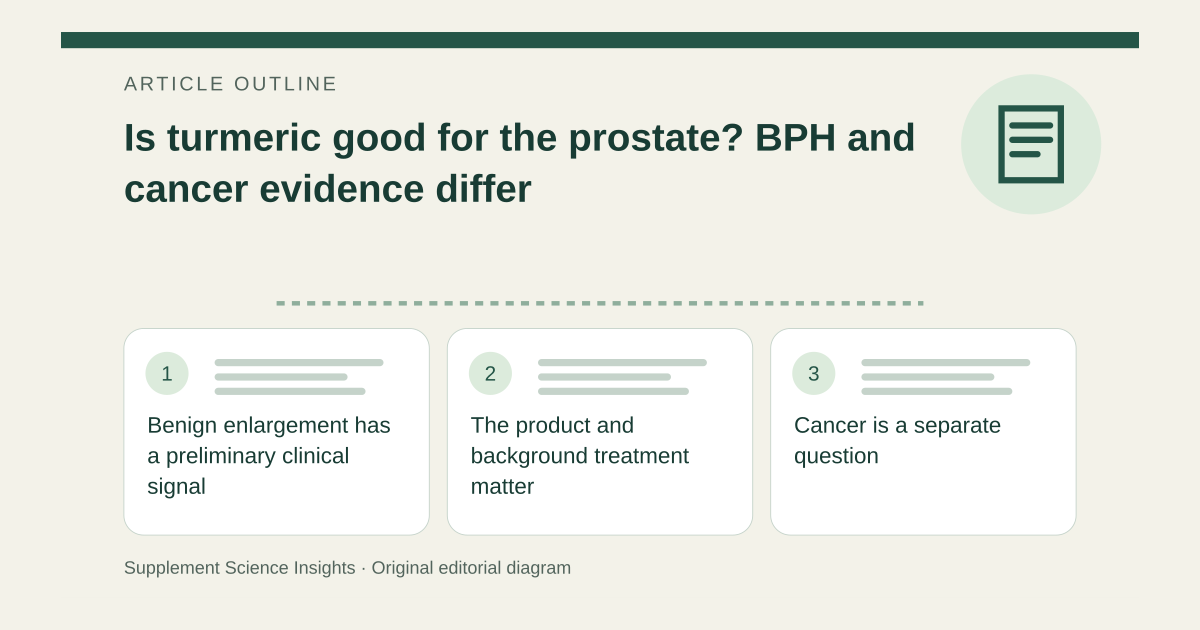
Benign enlargement has a preliminary clinical signal
A 2026 review included six comparative studies involving 697 men with BPH, generally receiving standard prostate medicines. It found improved urinary symptom scores and some functional measurements with curcumin-based supplementation. The evidence included mixed study designs and substantial heterogeneity, so the result is best viewed as a potential adjunctive signal. [1]
The product and background treatment matter
The review did not establish one optimal formulation or long-term regimen. Results from patients taking alpha-blockers or other standard medicines do not prove that turmeric alone works equally well. Household spice amounts also cannot be substituted directly for a studied preparation. [1][2]
Cancer is a separate question
A systematic review of clinical cancer trials, including prostate cancer studies, found evidence insufficient to support curcumin as a cancer treatment. Preclinical mechanisms and urinary-symptom improvement do not establish tumor control or longer survival. Continue oncology care rather than replacing it with a supplement. [3]
Do not use a supplement to interpret a PSA result
Prostate symptoms and PSA changes require clinical context. A lower value in a BPH study is not proof that a suspicious finding is harmless. Assessment can distinguish enlargement from other causes and identify problems requiring more urgent care, including inability to pass urine. [4][5]
Set the clinical goal before adding turmeric
Imagine urinary symptoms improve somewhat while investigations are still pending. Tell the clinician about all medicines and supplements and complete the assessment. A symptom change does not identify the underlying cause or settle the cancer question. [4][1][6]
| Outcome | What it does not establish |
|---|---|
| Improved BPH symptom score | Not proof of cancer treatment |
| Changed PSA | Not a diagnosis by itself |
| Adjunct study result | Not evidence for replacing standard medicines |
| Promising mechanism | Not a demonstrated survival benefit |
Sources for this article
- Curcumin versus placebo in benign prostatic hyperplasia: a systematic review and meta-analysis - PMC
Source consulted: 2026-09-21. This is a reference resource, not a claim that we conducted the studies or tested a product. - Turmeric: Usefulness and Safety | NCCIH
Source consulted: 2026-09-21. This is a reference resource, not a claim that we conducted the studies or tested a product. - Exploring the Contribution of Curcumin to Cancer Therapy: A Systematic Review of Randomized Controlled Trials.
Source consulted: 2026-09-21. This is a reference resource, not a claim that we conducted the studies or tested a product. - Enlarged Prostate (Benign Prostatic Hyperplasia) - NIDDK
Source consulted: 2026-09-21. This is a reference resource, not a claim that we conducted the studies or tested a product. - Prostate Problems - NIDDK
Source consulted: 2026-09-21. This is a reference resource, not a claim that we conducted the studies or tested a product. - Turmeric | Memorial Sloan Kettering Cancer Center
Source consulted: 2026-09-21. This is a reference resource, not a claim that we conducted the studies or tested a product.