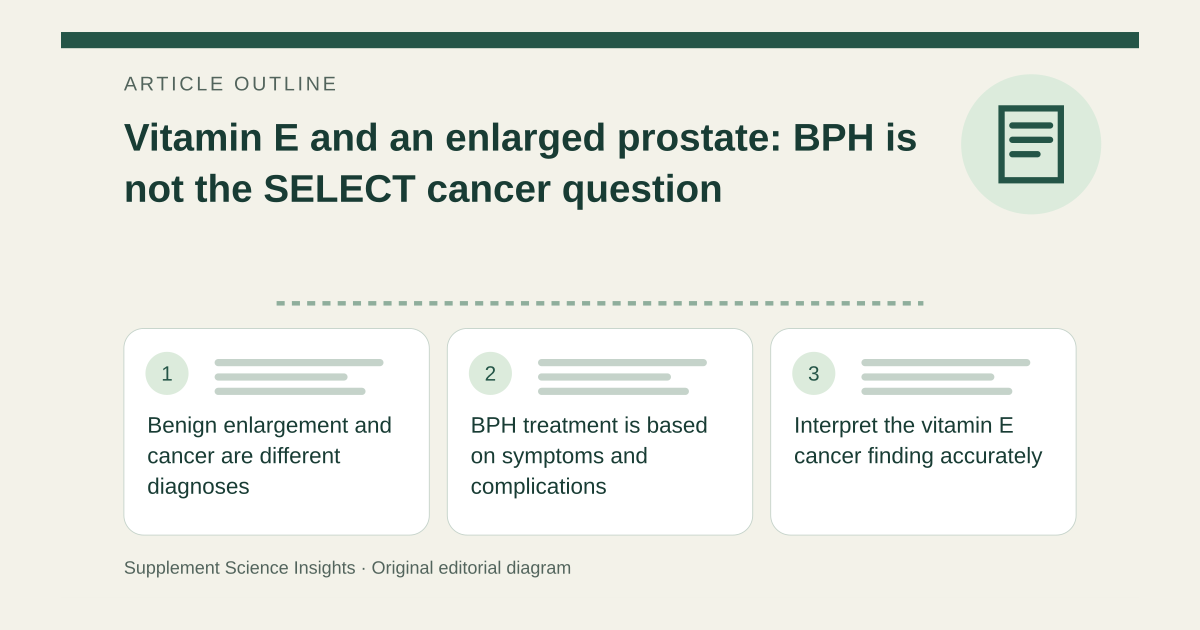
Benign enlargement and cancer are different diagnoses
NIDDK describes BPH as noncancerous prostate enlargement that can affect urine flow. Urinary symptoms can also have other causes, so a self-diagnosis based on age or nighttime urination is not enough. [1]
BPH treatment is based on symptoms and complications
NIDDK describes monitoring, lifestyle measures, medicines and procedures depending on severity. The inspected guidance does not establish vitamin E as a prostate-shrinking therapy. Do not delay a treatment review while waiting for an antioxidant supplement to relieve obstruction. [1]
Interpret the vitamin E cancer finding accurately
NIH’s summary of SELECT reports that high-dose supplemental vitamin E did not prevent prostate cancer and was associated with increased prostate-cancer risk during follow-up. That finding concerns cancer incidence in the studied setting, not proof that vitamin E causes benign enlargement or that vitamin E in ordinary food should be avoided. [2]
Other supplement risks still apply
High-dose vitamin E can increase bleeding risk and may matter with medicines or procedures. Bring the exact product to a urology or pharmacy review. A prostate-health label does not establish benefit for the actual urinary problem. [2][3]
Know when urinary symptoms are urgent
NIDDK advises immediate medical contact for inability to urinate, blood in urine, severe lower abdominal or urinary pain, or urinary symptoms with fever and chills. Imagine urine flow suddenly stops: that is an urgent clinical problem, not a reason to try a stronger supplement. [1]
| Issue | Distinction |
|---|---|
| BPH | Benign enlargement and urinary symptoms |
| SELECT finding | Cancer-risk outcome, not BPH treatment |
| Supplement dose | Benefit and harm need separate evidence |
| Cannot urinate | Urgent medical attention |
Sources for this article
- Enlarged Prostate (Benign Prostatic Hyperplasia) - NIDDK
Source consulted: 2026-09-21. This is a reference resource, not a claim that we conducted the studies or tested a product. - Vitamin E - Health Professional Fact Sheet
Source consulted: 2026-09-21. This is a reference resource, not a claim that we conducted the studies or tested a product. - Dietary Supplements: What You Need to Know
Source consulted: 2026-09-21. This is a reference resource, not a claim that we conducted the studies or tested a product.