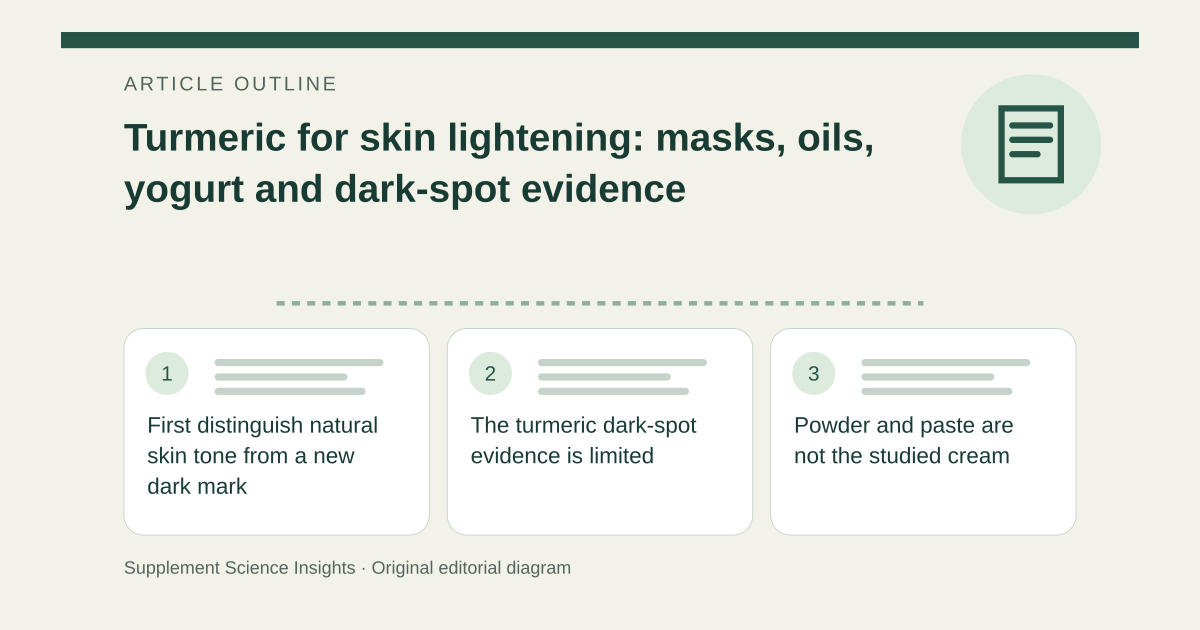
First distinguish natural skin tone from a new dark mark
Hyperpigmentation can follow acne, eczema, injury or irritation and can also have other causes. AAD recommends identifying and treating the trigger. Changing normal skin color and treating a specific post-inflammatory mark are different goals; a kitchen ingredient should not be presented as a universal way to do either. [1]
The turmeric dark-spot evidence is limited
A systematic review of natural ingredients described a favorable signal from a turmeric-extract cream, but the underlying report was an abstract with incomplete information, including an unclear control formulation. The reviewers called for further clinical studies. That is preliminary evidence, not a basis for promising a percentage of improvement from a household mask. [2]
Powder and paste are not the studied cream
Mixing turmeric powder into a paste does not reproduce an extract’s concentration, delivery or full formulation. There is no validated home whitening ratio or application schedule established by these sources. Yellow surface staining should not be confused with reduced melanin or lasting correction of hyperpigmentation. [2][3]
Adding yogurt does not validate the mixture
The reviewed turmeric evidence does not establish turmeric-and-yogurt masks as an effective lightening treatment. Adding a familiar food changes the mixture rather than supplying the missing clinical trial. A soothing feel or temporary surface change is not proof that a dark spot will fade, and irritation remains possible. [2][3]
Homemade turmeric oil has the same evidence gap
Infusing turmeric into a carrier oil does not create a proven depigmenting product. Essential oil is a separate volatile preparation, not interchangeable with curcumin cream. Do not apply concentrated essential oil or escalate a homemade mixture to chase faster lightening; follow the directions of a finished skin product and stop a reaction. [4][5]
Protect against further pigmentation
AAD notes that irritation itself can produce dark marks. It recommends gentle care and sun protection, including appropriate broad-spectrum SPF 30 or higher sunscreen; tinted products with iron oxide can also help protect against visible light. Cause-directed options such as azelaic acid or retinoids may be considered with appropriate guidance. [1]
There is no dependable turmeric response deadline
A few weeks in an exploratory extract study does not predict how long an individual mask takes to work. AAD describes ordinary fading over months after a trigger is controlled, sometimes longer for deeper pigment. That is general pigmentation guidance, not a turmeric treatment timetable. [2][1]
Respond to irritation instead of intensifying the recipe
Imagine a turmeric-yogurt mask stings and the marks become darker. Wash it off, stop using it and use gentle care; seek dermatology advice for persistent or troublesome changes. Repeated irritation is not evidence of bleaching, detoxification or a necessary treatment stage. [6][1]
| Claim | Evidence boundary |
|---|---|
| Powder mask clears marks | Not established by an extract-cream study |
| Yogurt makes it effective | Combination needs its own evidence |
| Turmeric oil lightens skin | Not a validated home treatment |
| Yellow stain means improvement | Surface color is not reduced melanin |
| A guaranteed result in days | No dependable turmeric timetable |
Sources for this article
- How to fade dark spots in darker skin tones
Source consulted: 2026-09-21. This is a reference resource, not a claim that we conducted the studies or tested a product. - Are Natural Ingredients Effective in the Management of Hyperpigmentation? A Systematic Review - PMC
Source consulted: 2026-09-21. This is a reference resource, not a claim that we conducted the studies or tested a product. - Turmeric: Usefulness and Safety | NCCIH
Source consulted: 2026-09-21. This is a reference resource, not a claim that we conducted the studies or tested a product. - Curcuma longa L. Rhizome Essential Oil from Extraction to Its Agri-Food Applications. A Review - PMC
Source consulted: 2026-09-21. This is a reference resource, not a claim that we conducted the studies or tested a product. - Essential oils: Poisonous when misused | Poison Control
Source consulted: 2026-09-21. This is a reference resource, not a claim that we conducted the studies or tested a product. - How to test skin care products
Source consulted: 2026-09-21. This is a reference resource, not a claim that we conducted the studies or tested a product.