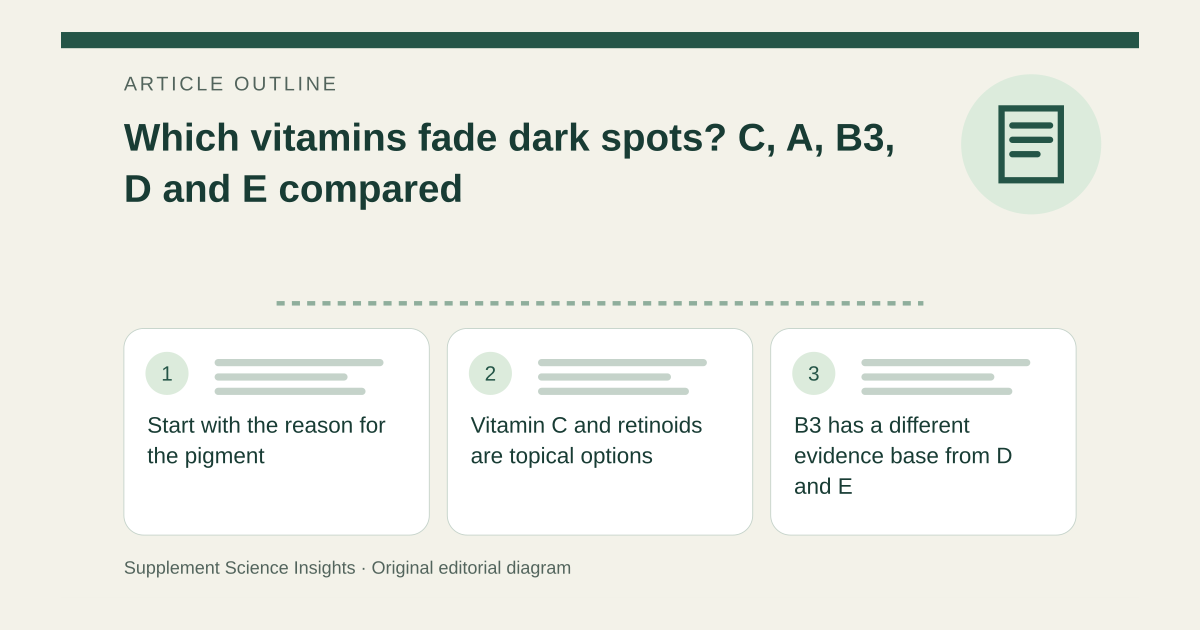
Start with the reason for the pigment
AAD explains that acne, irritation and other skin conditions can leave dark marks, while continued exposure and ongoing inflammation can sustain them. Treating the cause and using appropriate sunscreen are central steps. A new or changing lesion should be assessed rather than assumed to be routine hyperpigmentation. [1]
Vitamin C and retinoids are topical options
AAD includes vitamin C and retinoids such as retinol and tretinoin among ingredients that can fade existing dark spots. A retinoid formulation is not equivalent to swallowing vitamin A, and a topical C product is not equivalent to drinking juice. Irritation can worsen pigmentation, so the routine must be tolerated. [1]
B3 has a different evidence base from D and E
DermNet describes improvement in pigmentation with topical niacinamide, a B3 form. That does not establish identical effects from all B3 products. Vitamin D and E have nutritional functions, but those functions alone do not make them proven dark-spot treatments or justify high-dose oral supplementation. [2][3][4]
A five-vitamin list can hide more useful choices
The relevant comparison is between appropriate treatments, not five winners chosen to fill a list. AAD also names non-vitamin options such as azelaic acid and other pigment-targeting ingredients. Sunscreen and control of the underlying condition remain important regardless of the active ingredient selected. [1]
Choose one coherent routine
Imagine someone combines a retinoid, several acids and a vitamin C serum, then develops burning and darker marks. Adding another vitamin is not the obvious solution. Reduce irritation and seek help choosing a tolerable regimen that matches the diagnosis. [1]
| Label | Evidence distinction |
|---|---|
| C | Topical option in AAD guidance |
| A | Retinoid formulation, not oral megadosing |
| B3 | Topical niacinamide has pigmentation evidence |
| D and E | Nutrient functions do not establish a dark-spot cure |
Sources for this article
- How to fade dark spots in darker skin tones
Source consulted: 2026-09-21. This is a reference resource, not a claim that we conducted the studies or tested a product. - Nicotinamide
Source consulted: 2026-09-21. This is a reference resource, not a claim that we conducted the studies or tested a product. - Vitamin D - Health Professional Fact Sheet
Source consulted: 2026-09-21. This is a reference resource, not a claim that we conducted the studies or tested a product. - Vitamin E - Health Professional Fact Sheet
Source consulted: 2026-09-21. This is a reference resource, not a claim that we conducted the studies or tested a product.