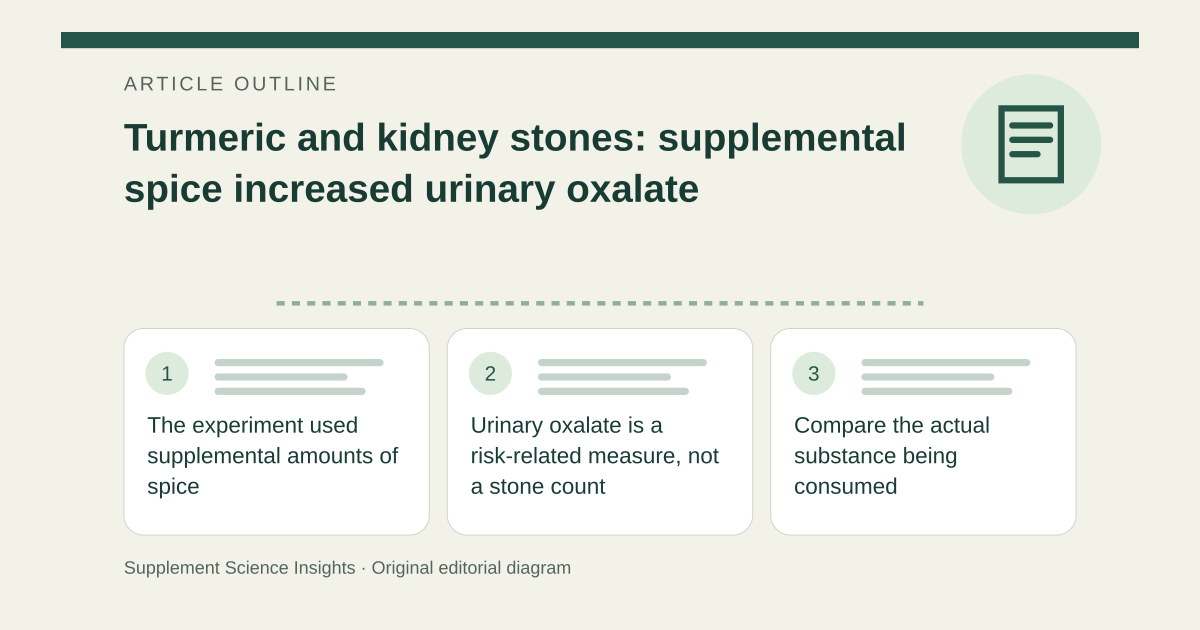
The experiment used supplemental amounts of spice
Eleven healthy adults participated in an eight-week crossover study with four-week cinnamon and turmeric periods. The supplements supplied matched daily oxalate amounts, and investigators performed oxalate-load tests. [1]
Turmeric produced greater urinary oxalate excretion. Much more of its measured oxalate was water-soluble than the oxalate in cinnamon, providing a plausible explanation for the difference. [1]
Urinary oxalate is a risk-related measure, not a stone count
The study did not follow a large population for new kidney stones. It cannot assign an individual probability of stones or show that every purified curcumin extract contains the same oxalate exposure as the tested spice. [1]
Funding and conflicts were not established from the abstract. People with a calcium oxalate stone history should discuss concentrated turmeric use in the context of their stone-prevention plan. The study also found no significant fasting glucose or lipid improvement during these short supplementation periods. [1]
Compare the actual substance being consumed
Imagine one product contains whole turmeric powder and another a purified extract. The same curcumin label amount would not establish equal oxalate content.
| Detail | Interpretation |
|---|---|
| Urinary oxalate | Increased after turmeric |
| 11 participants | Small physiological study |
| All curcumin extracts | Not compositionally equivalent |
Sources for this article
- Effect of cinnamon and turmeric on urinary oxalate excretion, plasma lipids, and plasma glucose in healthy subjects - PubMed
Source consulted: 2026-09-19. This is a reference resource, not a claim that we conducted the studies or tested a product.