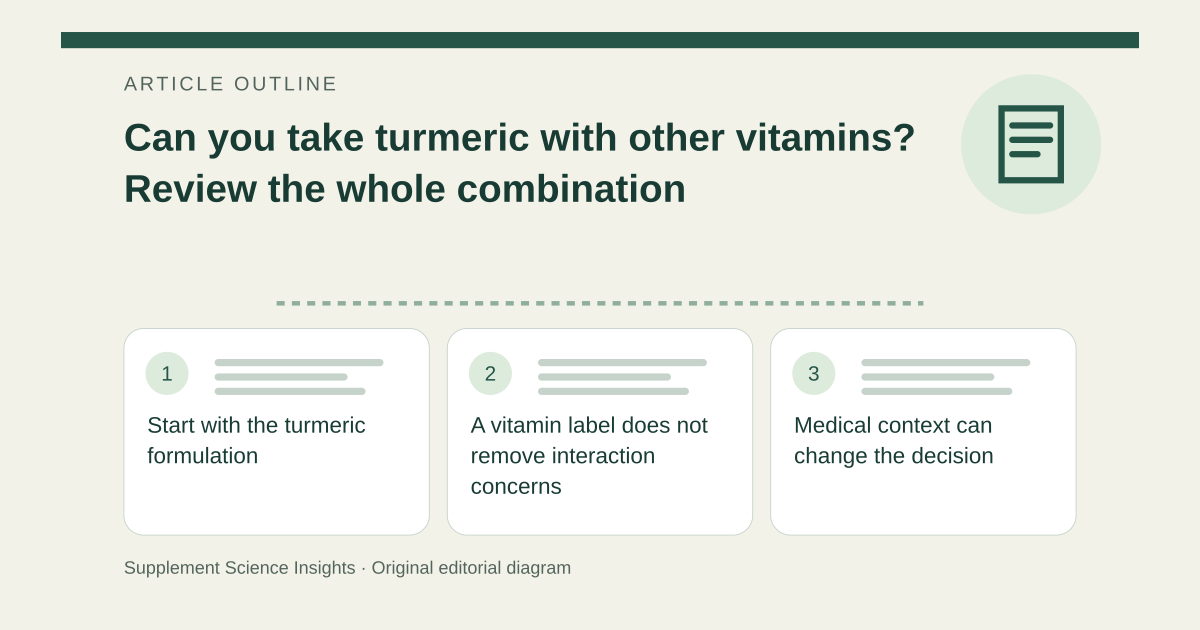
Start with the turmeric formulation
NCCIH notes substantial differences among curcumin products, including added piperine to increase absorption. Highly bioavailable formulations have been associated with liver injury. Safety cannot be inferred solely from having eaten turmeric in meals. [1]
A vitamin label does not remove interaction concerns
Some vitamin doses have their own risks. NIH describes bleeding concerns with high-dose vitamin E, while Medsafe warns about turmeric or curcumin with warfarin. These are reasons to review the whole regimen, especially medicines affecting clotting, rather than declare a universal turmeric-plus-vitamin prohibition or approval. [2][3]
Medical context can change the decision
MSK describes medication interactions and cautions for turmeric supplements, including in cancer-treatment settings. Liver problems, planned procedures and multiple medicines are reasons to ask the treating team about the exact product. Separating two products by an hour does not necessarily eliminate a biological interaction. [4][1]
Do not assume more absorption is always better
An absorption-enhanced product may change exposure as well as any desired effect. Compare the amount of curcuminoids, the other ingredients and the reason for taking it. A daily multivitamin and a high-dose individual vitamin deserve separate review because their exposures differ. [1][5]
Make the review concrete
Imagine someone takes a multivitamin, extra vitamin E and warfarin, then adds a turmeric-piperine capsule. Bring all labels and medicines to the pharmacist or prescriber before combining them. The concern is the complete exposure and clinical context, not whether turmeric and vitamins are both described as natural. [3][2][1]
| Detail | Why it matters |
|---|---|
| Food spice or extract | Different concentration |
| Piperine or enhanced absorption | Can alter exposure |
| Separate high-dose vitamins | May add their own risks |
| Anticoagulants and other medicines | Require specific interaction review |
Sources for this article
- Turmeric: Usefulness and Safety | NCCIH
Source consulted: 2026-09-21. This is a reference resource, not a claim that we conducted the studies or tested a product. - Vitamin E - Health Professional Fact Sheet
Source consulted: 2026-09-21. This is a reference resource, not a claim that we conducted the studies or tested a product. - Beware turmeric/curcumin containing products can interact with warfarin
Source consulted: 2026-09-21. This is a reference resource, not a claim that we conducted the studies or tested a product. - Turmeric | Memorial Sloan Kettering Cancer Center
Source consulted: 2026-09-21. This is a reference resource, not a claim that we conducted the studies or tested a product. - Multivitamin/mineral Supplements
Source consulted: 2026-09-21. This is a reference resource, not a claim that we conducted the studies or tested a product.