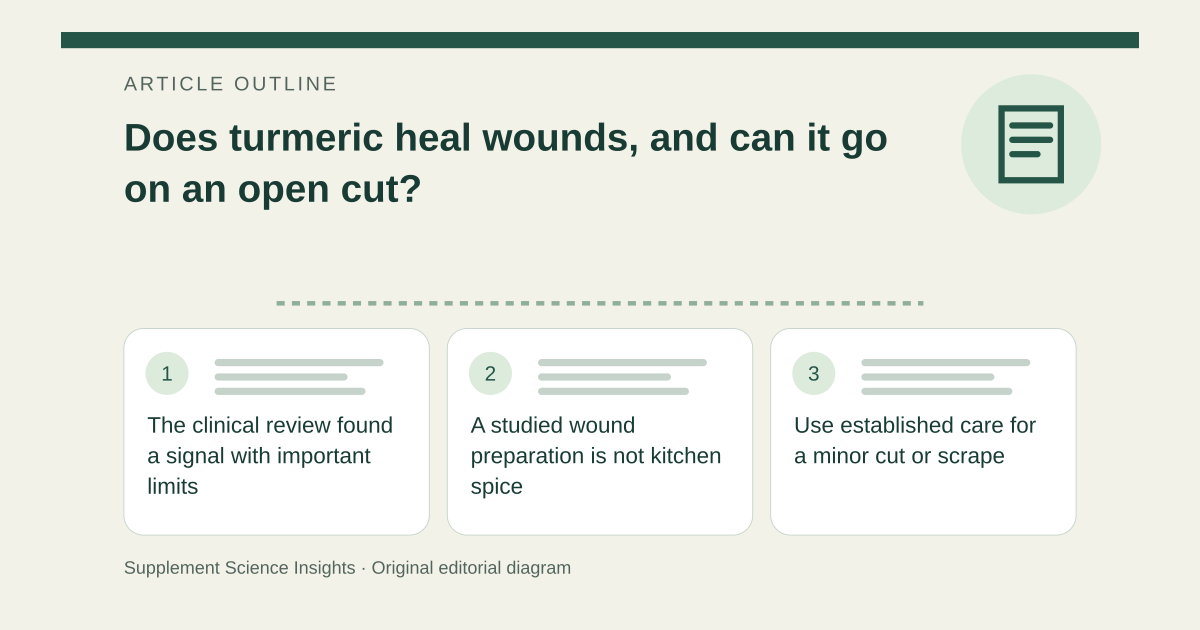
The clinical review found a signal with important limits
A 2025 scoping review included nineteen clinical trials of different curcumin formulations and wound types. Many reported favorable results, but the reviewers did not perform a risk-of-bias assessment and could not pool the diverse outcomes. Its positive conclusion should therefore be read as a preliminary overview rather than a universal wound-treatment recommendation. [1]
A studied wound preparation is not kitchen spice
The studies used defined interventions in specific care settings. The review does not establish that sprinkling turmeric powder onto an open cut or applying a homemade oil improves healing. Such products are not equivalent to the wound formulation or clinical care used in a trial. Essential oils should not be applied to damaged skin. [1][2]
Use established care for a minor cut or scrape
AAD advises gently cleaning the wound with mild soap and water, keeping it moist with petroleum jelly and covering it with an appropriate bandage. Change the dressing as directed and follow a clinician’s instructions for stitches or other treated wounds. These steps address everyday wound care without needing turmeric. [3]
Know when home care is insufficient
A deep or very painful injury, or a wound that appears infected, needs medical care. Do not delay assessment while waiting for a turmeric paste to work. Chronic or postoperative wounds also require the care plan appropriate to their cause and procedure. [3]
Keep healing and scar appearance separate
Imagine a cut closes while a mark remains. Closure and later scar appearance are different outcomes. Once the wound has healed, sun protection can help reduce discoloration; adding powder to the healing tissue is not established scar prevention. [3][1]
| Situation | Approach |
|---|---|
| Minor cut or scrape | Clean, keep moist and cover |
| Deep, painful or infected wound | Seek medical care |
| Clinical curcumin wound product | Evidence applies to that preparation and setting |
| Kitchen powder or essential oil | Not a substitute for wound care |
Sources for this article
- A Scoping Review of Clinical Trials on the Efficacy of Curcumin and Its Formulations for Wound Healing - PMC
Source consulted: 2026-09-21. This is a reference resource, not a claim that we conducted the studies or tested a product. - Essential oils: Poisonous when misused | Poison Control
Source consulted: 2026-09-21. This is a reference resource, not a claim that we conducted the studies or tested a product. - Minimize a scar: Proper wound care tips from dermatologists
Source consulted: 2026-09-21. This is a reference resource, not a claim that we conducted the studies or tested a product.