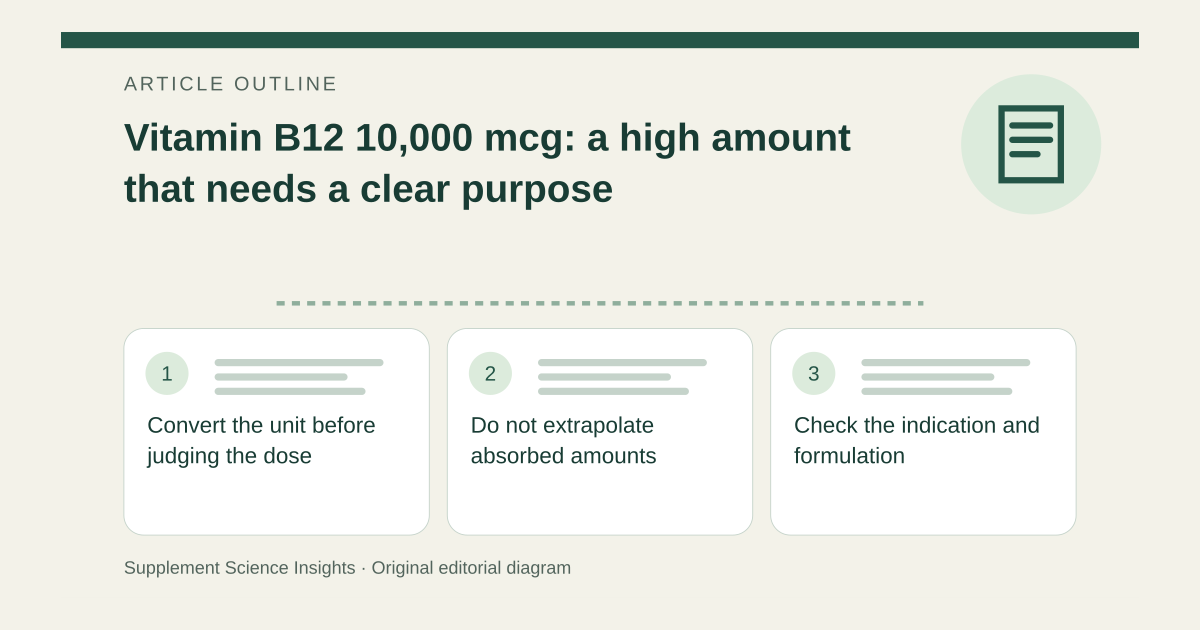
Convert the unit before judging the dose
A 10,000 mcg product supplies 10 mg B 12. Compared with the 2.4 mcg adult RDA, it contains over 4,000 times the nutritional reference amount. That ratio alone does not diagnose poisoning: treatment doses and absorption are different from daily food requirements. It does show that the amount is not a routine requirement-sized supplement. [1]
Do not extrapolate absorbed amounts
At high oral doses, only a small percentage is absorbed. NIH ODS gives examples for 500 and 1,000 mcg doses; those percentages should not be extrapolated mechanically to 10,000 mcg to calculate someone’s absorbed dose. There is no established U.S. B 12 upper intake level, but that does not demonstrate an advantage for this dose. [1]
Check the indication and formulation
Imagine an online product advertises 10,000 mcg for energy while a clinician has prescribed a different replacement schedule. The marketing amount is not a reason to substitute regimens. Verify the actual serving, whether the product contains only B 12, and why a high dose would be used. Unexplained fatigue needs assessment rather than repeated dose escalation. [1]
| Hypothetical quantity | Interpretation |
|---|---|
| 10,000 mcg | 10 mg |
| Adult RDA 2.4 mcg | Nutritional reference |
| High-dose absorption estimate | Cannot be inferred reliably by linear scaling |
Sources for this article
- Vitamin B12 - Health Professional Fact Sheet
Source consulted: 2026-09-20. This is a reference resource, not a claim that we conducted the studies or tested a product.