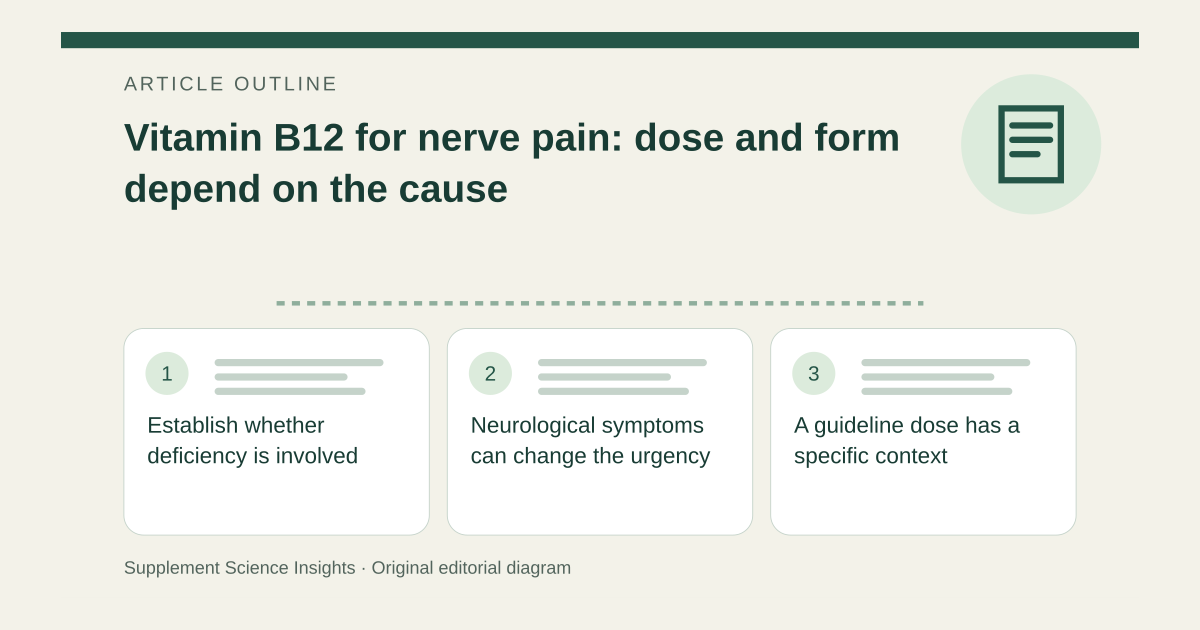
Establish whether deficiency is involved
NHS lists B12 deficiency as one treatable cause of peripheral neuropathy, alongside other causes such as diabetes or medicine effects. Pain alone does not establish B12 deficiency, and correcting a deficiency does not guarantee that every source of nerve pain resolves. [1][2]
Neurological symptoms can change the urgency
NICE advises not delaying replacement while awaiting results when megaloblastic anemia and neurological symptoms raise concern for B12 deficiency. Worsening numbness, balance or walking problems should be assessed promptly rather than managed by comparing online supplement brands. [3]
A guideline dose has a specific context
NICE recommends at least 1 mg daily when oral replacement is prescribed for confirmed or suspected malabsorption. That equals 1,000 micrograms and is not a universal dose for unexplained nerve pain. NHS notes that cyanocobalamin dosing depends on the B12 level and why it is low. [3][4]
Oral and injected routes are not interchangeable in every situation
NICE recommends lifelong intramuscular replacement for particular irreversible causes, including autoimmune gastritis, total gastrectomy or complete terminal ileal resection. Other malabsorption or significant neurological circumstances may also favor injections. The treating clinician should select the route and schedule. [3]
Methylcobalamin is not automatically the best pain treatment
NICE lists cyanocobalamin, methylcobalamin and adenosylcobalamin as acceptable forms in relevant oral supplements. A form name alone does not establish superior nerve-pain relief. Adequate replacement, absorption and follow-up matter more than a marketing claim about an active form. [3][2]
Follow symptoms as well as the regimen
NICE says improvement can begin within two weeks but may take up to three months, with full symptom resolution taking longer. Seek review for new, worsening or persistent symptoms. Imagine a person with malabsorption and numbness chooses a low-dose gummy: the key question is whether it meets the prescribed replacement plan, not whether its label promises nerve support. [3]
| Detail | Decision it informs |
|---|---|
| Deficiency confirmed or suspected | Need for replacement |
| Malabsorption | Dose and route |
| Neurological progression | Prompt clinical review |
| Form name alone | Does not establish superior pain relief |
Sources for this article
- Peripheral neuropathy - Treatment - NHS
Source consulted: 2026-09-21. This is a reference resource, not a claim that we conducted the studies or tested a product. - Vitamin B12 - Health Professional Fact Sheet
Source consulted: 2026-09-21. This is a reference resource, not a claim that we conducted the studies or tested a product. - Recommendations | Vitamin B12 deficiency in over 16s: diagnosis and management | Guidance | NICE
Source consulted: 2026-09-21. This is a reference resource, not a claim that we conducted the studies or tested a product. - How and when to take cyanocobalamin - NHS
Source consulted: 2026-09-21. This is a reference resource, not a claim that we conducted the studies or tested a product.