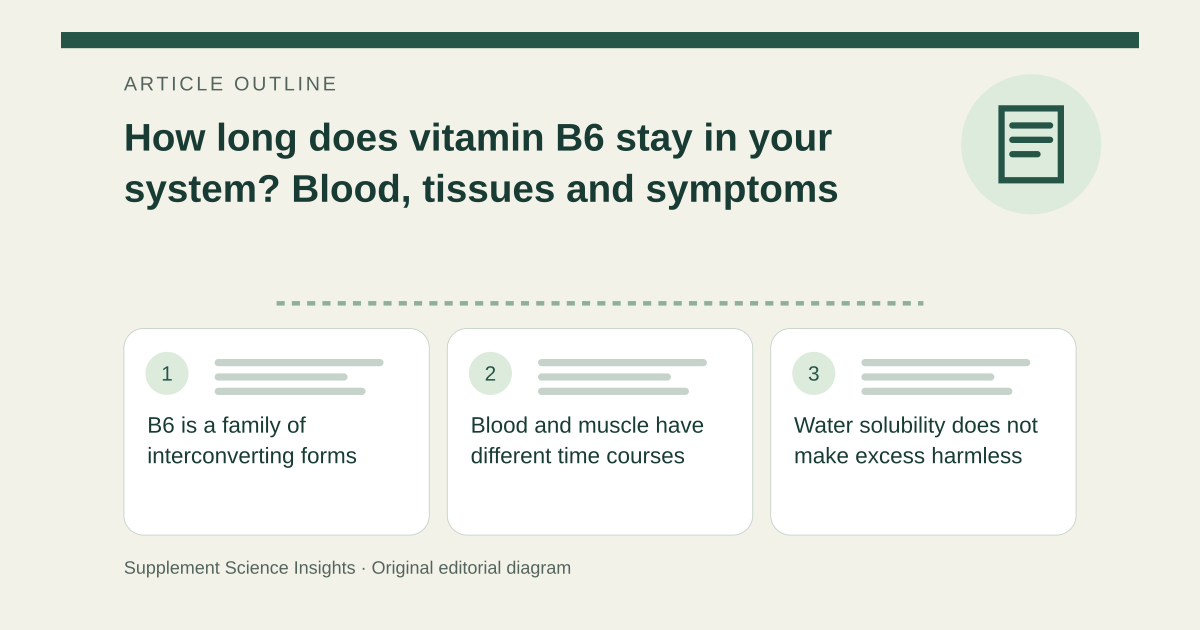
B6 is a family of interconverting forms
Pyridoxine is one form; pyridoxal phosphate, often abbreviated PLP, is an important active coenzyme. The body absorbs, converts, transports and uses these forms. A measurement of one circulating form is not a count of every B6 molecule in all tissues. [1][2]
Blood and muscle have different time courses
EFSA describes a rapidly responding circulating pool and a slower muscle pool. Its review reports circulating steady state within about seven days under the studied conditions. Steady state means a balance during an intake pattern, not that the entire body is free of B6 seven days after stopping a product. [2]
Water solubility does not make excess harmless
The liver converts B6 compounds into breakdown products, with urine a major elimination route. Some B6 remains associated with proteins and tissue enzymes. Calling it water-soluble therefore does not justify repeatedly taking large amounts or assuming that any excess is instantly removed. [2][1]
A test result and recovery are different questions
Dose, repeated use and the particular measurement matter when interpreting a result. Excess supplemental B6 can injure sensory nerves. Tingling, numbness or balance problems need medical assessment; a predicted clearance date cannot establish when symptoms will resolve or exclude other causes. Bring all supplement labels to the review. [1][2]
Use the timeline for the right purpose
Imagine a person stops a high-B6 product and a later blood test falls. That supports a change in the measured circulating level. It does not prove that all tissue pools changed at the same rate or that persistent symptoms are unrelated. Follow the clinician’s testing and symptom-assessment plan rather than a universal internet countdown. [1][2]
| Measurement or process | Meaning |
|---|---|
| Blood PLP | One marker of status |
| Circulating steady state | Balance under a given intake pattern |
| Muscle pool | Slower tissue turnover |
| Symptom recovery | Requires clinical follow-up, not a clearance calculation |
Sources for this article
- Vitamin B6 - Health Professional Fact Sheet
Source consulted: 2026-09-21. This is a reference resource, not a claim that we conducted the studies or tested a product. - Dietary Reference Values for vitamin B6 - PMC
Source consulted: 2026-09-21. This is a reference resource, not a claim that we conducted the studies or tested a product.