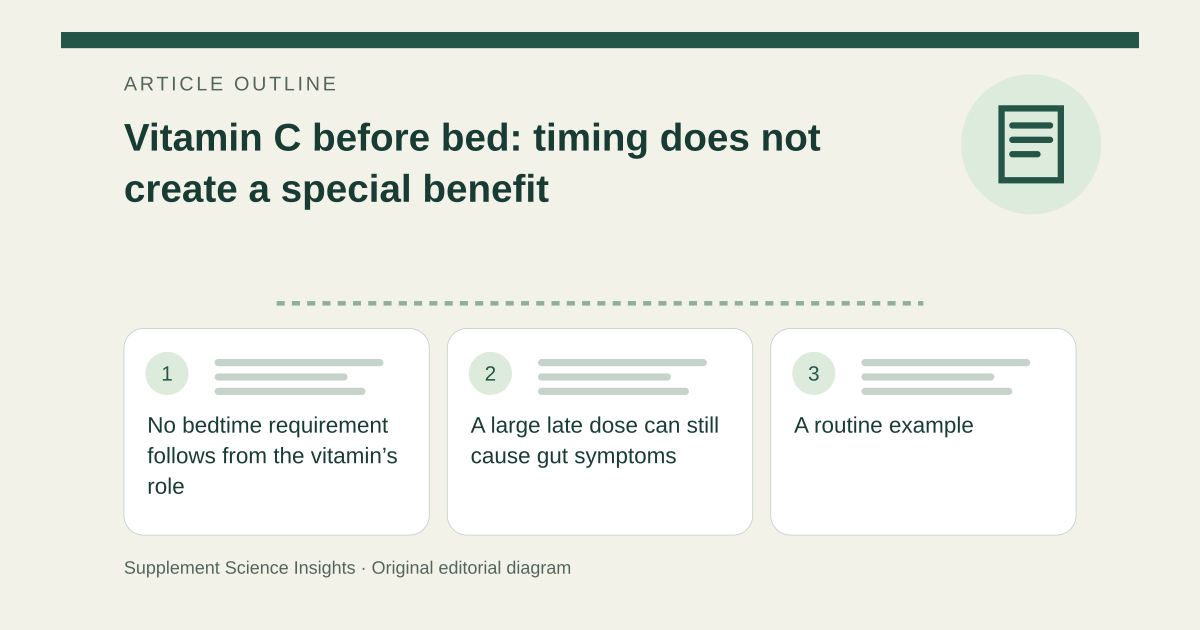
No bedtime requirement follows from the vitamin’s role
Vitamin C is needed for collagen synthesis and normal immune function. Neither role establishes that taking it immediately before sleep improves its effect. NIH ODS describes dose-dependent absorption and regulated blood concentrations, not a universal bedtime dosing requirement. [1]
A large late dose can still cause gut symptoms
High intake can cause nausea, cramps or diarrhea whether taken in the morning or evening. Moving a large amount to bedtime does not change its daily total or make overlapping supplements disappear. The usual adult upper limit is 2,000 mg from all sources and is not a sleep target. [1]
A routine example
Imagine someone remembers a modest supplement more reliably at dinner than at breakfast. That can be a practical scheduling choice if consistent with the product and clinical instructions; it is not proof of a sleep or absorption advantage. If symptoms follow the dose, review the actual amount and formulation rather than assuming bedtime is always beneficial or always harmful. [1]
| Hypothetical reason for bedtime use | Interpretation |
|---|---|
| Easier to remember | Adherence consideration |
| Claim of better sleep | Not established by the cited nutrient functions |
| Large overlapping doses | Total remains the same at night |
Sources for this article
- Vitamin C - Health Professional Fact Sheet
Source consulted: 2026-09-20. This is a reference resource, not a claim that we conducted the studies or tested a product.