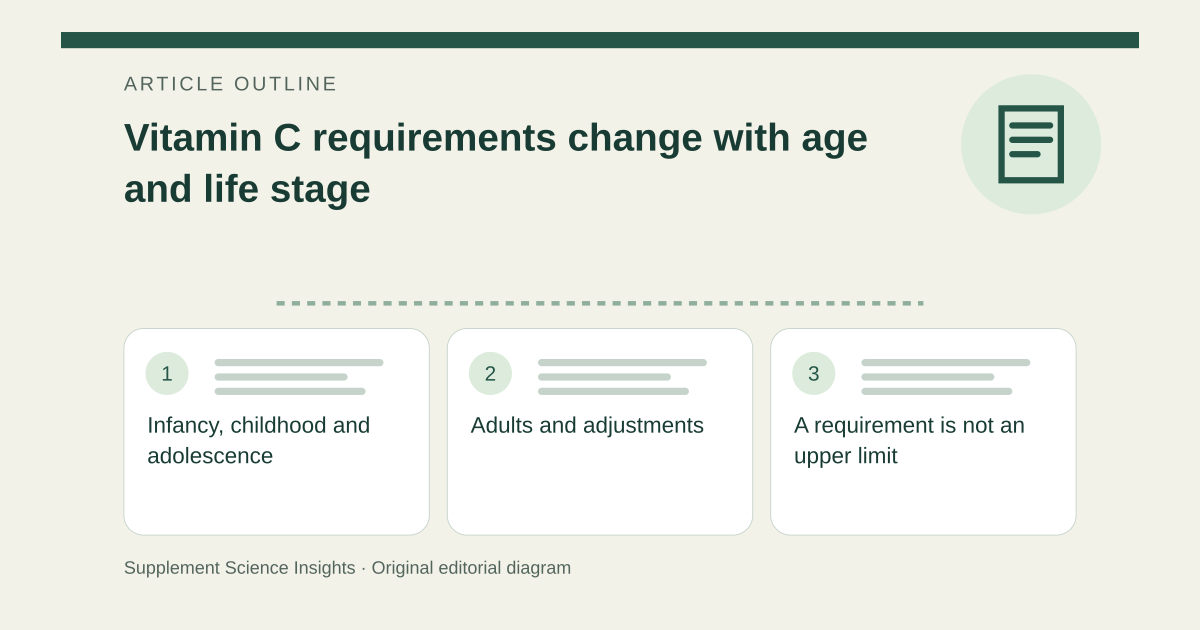
Infancy, childhood and adolescence
NIH ODS lists adequate intakes of 40 mg/day from birth through 6 months and 50 mg at 7–12 months. These infant values are nutritional references, not instructions to give a supplement. The RDA is 15 mg at 1–3 years,25 mg at 4–8 years and 45 mg at 9–13 years. At 14–18 years it is 75 mg for boys and 65 mg for girls; pregnancy is 80 mg and lactation 115 mg at those ages. [1]
Adults and adjustments
From age 19, the RDA is 90 mg for men and 75 mg for women,85 mg in pregnancy and 120 mg during lactation. People who smoke need 35 mg more daily than the corresponding nonsmoking reference. These are total-intake values, so a food contribution is not ignored when considering a supplement. [1]
A requirement is not an upper limit
The adult upper limit is 2,000 mg, with lower limits for children and teenagers. It is not a recommended amount. As a hypothetical example,75 mg from food plus 25 mg from a fortified drink gives 100 mg total; the arithmetic does not imply a 100 mg tablet is also needed. Clinical treatment can have a different purpose from ordinary nutritional planning. [1]
| Hypothetical contribution | Vitamin C |
|---|---|
| Food | 75 mg |
| Fortified drink | 25 mg |
| Daily total from those sources | 100 mg |
Sources for this article
- Vitamin C - Health Professional Fact Sheet
Source consulted: 2026-09-20. This is a reference resource, not a claim that we conducted the studies or tested a product.