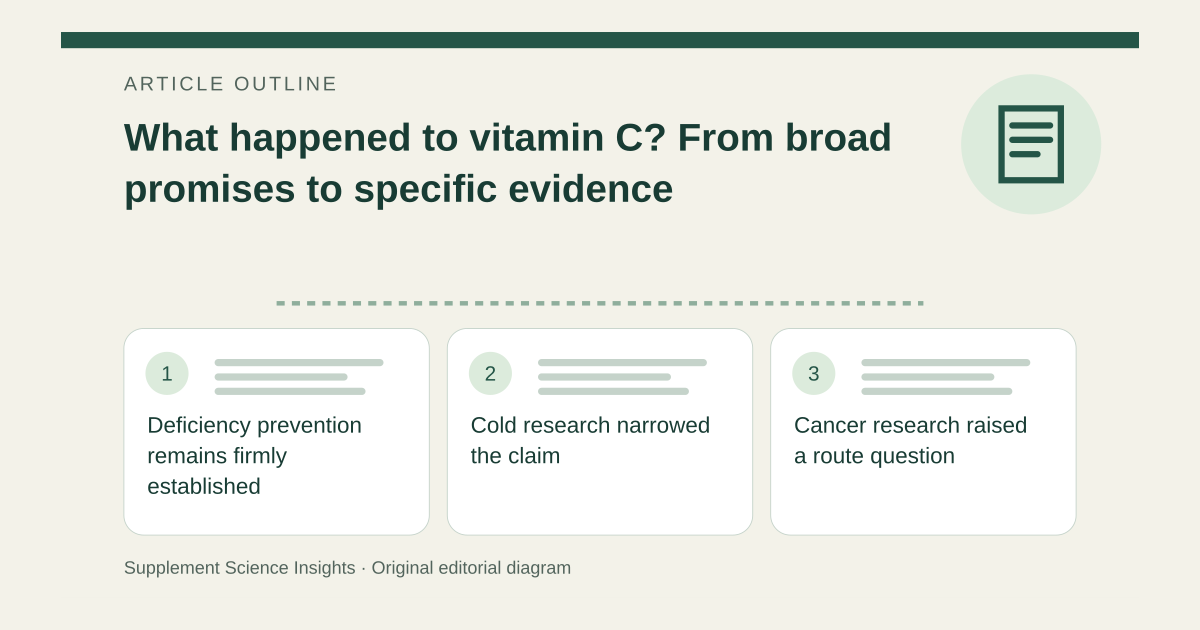
Deficiency prevention remains firmly established
NIH describes vitamin C requirements and its roles in collagen formation and other processes. These explain why inadequate intake can cause serious disease. They do not show that benefits keep increasing as intake rises far beyond nutritional requirements. [1]
Cold research narrowed the claim
Regular supplementation does not generally prevent colds in the general population, though it can modestly shorten duration and results differ in some unusually strenuous settings. Starting after symptoms begin has not shown consistent benefit. Prevention, duration and treatment timing should not be collapsed into one works-or-does-not-work statement. [1]
Cancer research raised a route question
NCI recounts early intravenous-related observations and later oral trials that did not reproduce broad benefits. IV dosing achieves different blood concentrations, so the routes cannot be treated as interchangeable. Current research does not turn this distinction into a general cancer cure or a substitute for established treatment. [2]
More exposure also changes risk
High oral doses can cause digestive problems. NCI identifies significant concerns for IV use in people with kidney disease, G6PD deficiency or iron overload. A nutrient being essential does not make every administration route and dose appropriate. [1][2]
Ask a narrower question than whether vitamin C works
Imagine comparing prevention of scurvy, shortening a cold and treating cancer as if they were one claim. Each needs different evidence, participants and outcomes. The useful lesson is to match the form, dose and study question to the benefit being promised. [1][2]
| Claim | Evidence question |
|---|---|
| Prevents deficiency disease | Adequate nutrient intake |
| Prevents a cold | Incidence in the studied population |
| Shortens an illness | Duration and timing |
| Treats cancer | Route-specific clinical outcomes and safety |
Sources for this article
- Vitamin C - Health Professional Fact Sheet
Source consulted: 2026-09-21. This is a reference resource, not a claim that we conducted the studies or tested a product. - Intravenous Vitamin C - NCI
Source consulted: 2026-09-21. This is a reference resource, not a claim that we conducted the studies or tested a product.