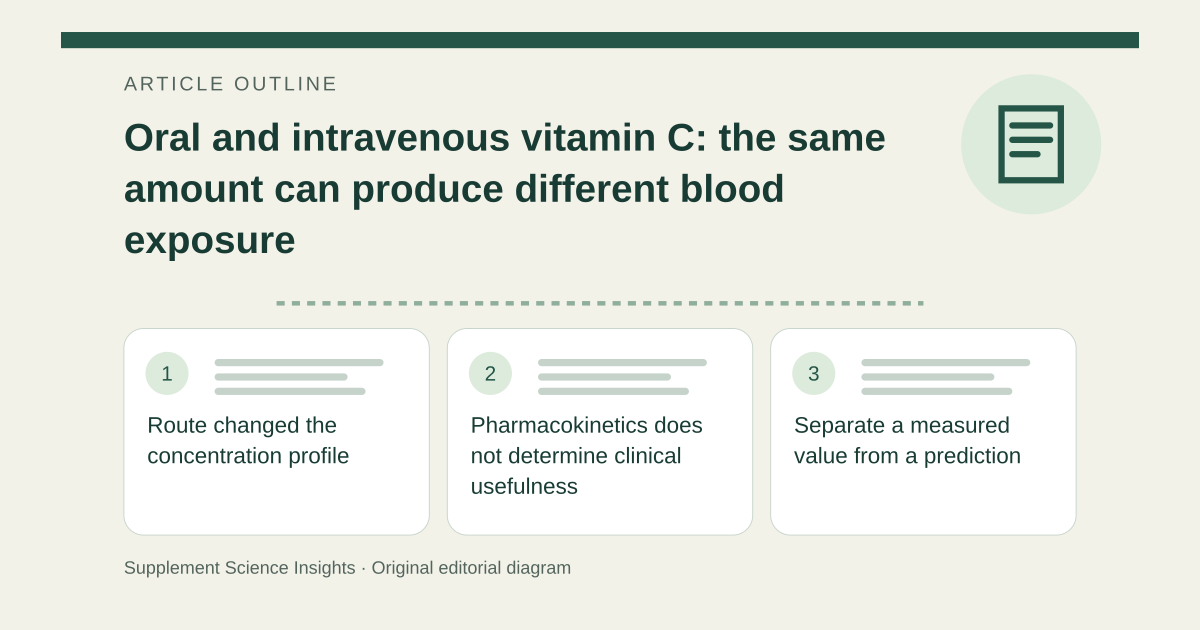
Route changed the concentration profile
Seventeen healthy volunteers took part in dose-concentration studies. At a measured dose of 1.25 grams, average peak plasma concentration was about 135 micromoles per liter after oral administration and 885 after intravenous administration. [1]
The investigators also modeled larger doses. Those model predictions were not direct measurements from cancer patients or validation of a treatment regimen. [1]
Pharmacokinetics does not determine clinical usefulness
The study helps explain why results from one administration route cannot simply be assigned to another. It does not prove that reaching a higher concentration improves energy, treats cancer or produces better outcomes for a healthy person. [1]
Funding and conflicts were not fully established from the abstract. The authors specifically noted the lack of patient data to confirm the high-dose modeling. An injection or infusion should be assessed for a defined clinical purpose and its risks, not judged beneficial solely because it bypasses intestinal absorption. [1]
Separate a measured value from a prediction
Imagine a study measures modest doses and uses a model for much larger ones. The predicted large-dose concentration should not be described as directly observed in patients.
| Detail | Interpretation |
|---|---|
| 17 volunteers | Measured population |
| Route of administration | Changed exposure |
| Clinical benefit | Separate question |
Sources for this article
- Vitamin C pharmacokinetics: implications for oral and intravenous use - PubMed
Source consulted: 2026-09-19. This is a reference resource, not a claim that we conducted the studies or tested a product.