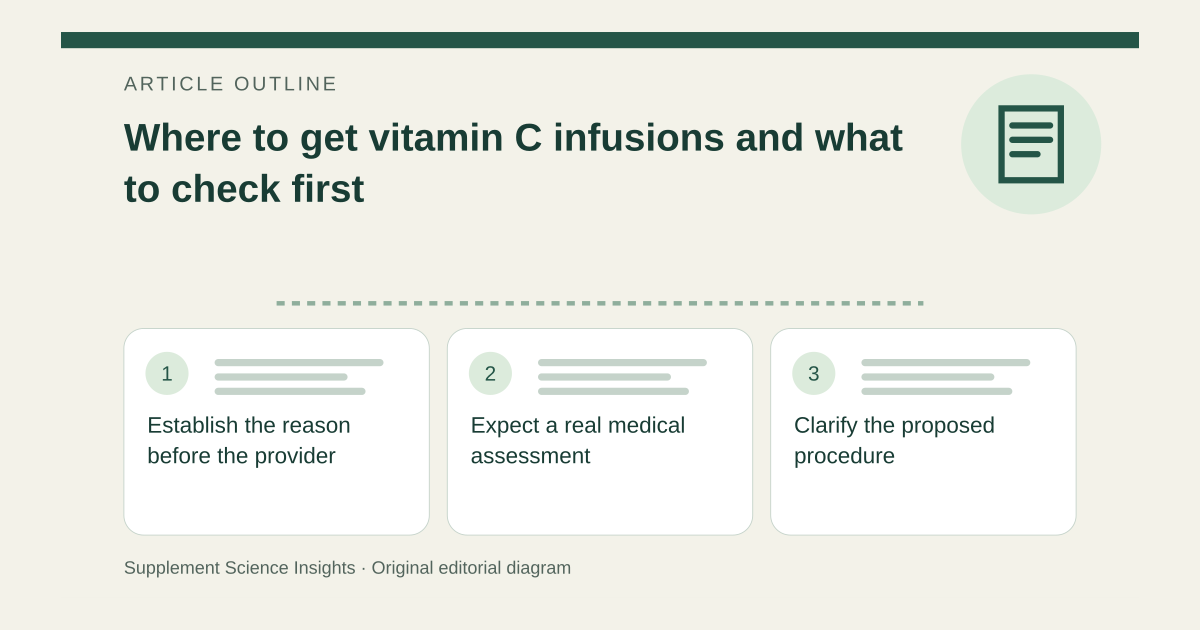
Establish the reason before the provider
NCI describes IV vitamin C as a subject of cancer research and does not present it as an FDA-approved cancer treatment. It should not replace established oncology care. A commercial service being available does not establish that an infusion benefits an otherwise healthy person or treats the advertised condition. [1]
Expect a real medical assessment
NCI identifies kidney disease, G6PD deficiency and hemochromatosis among situations with serious risk concerns. The treating clinician should review relevant history, medicines and appropriate testing before considering treatment. Ask who makes that decision and who is responsible if a complication occurs. [1]
Clarify the proposed procedure
An infusion delivers vitamin C directly into a vein and reaches different concentrations from oral intake. Ask about the exact contents, intended purpose, monitoring, adverse-effect plan and evidence for the claimed outcome. A multicomponent drip requires review of all ingredients, not just vitamin C. [1][2]
Use your existing care team to compare options
Imagine a person receiving cancer treatment finds a clinic promising an immune boost. Bring the proposal to the oncologist before booking. Trial eligibility or medically coordinated care is a more concrete discussion than assuming a storefront claim proves compatibility or benefit. [1]
| Question | Purpose |
|---|---|
| What condition and outcome? | Define the claimed benefit |
| What screening is needed? | Identify relevant risk factors |
| Who prescribes and monitors it? | Clarify clinical responsibility |
| What evidence supports this formulation? | Distinguish marketing from demonstrated benefit |
Sources for this article
- Intravenous Vitamin C - NCI
Source consulted: 2026-09-21. This is a reference resource, not a claim that we conducted the studies or tested a product. - Dietary Supplements: What You Need to Know
Source consulted: 2026-09-21. This is a reference resource, not a claim that we conducted the studies or tested a product.