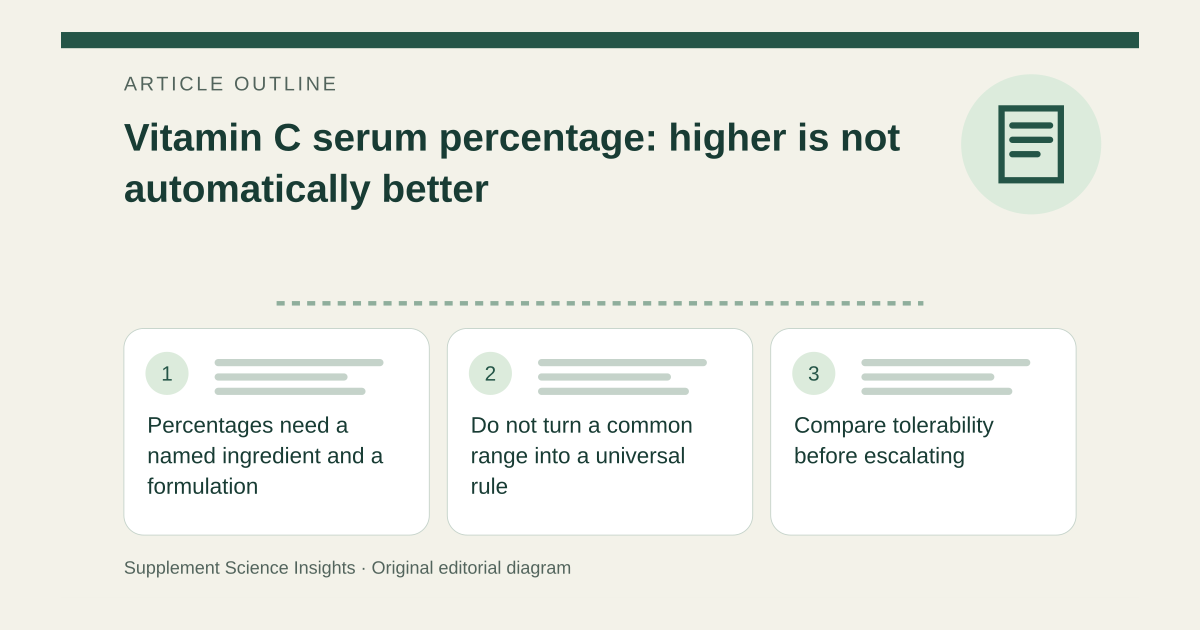
Percentages need a named ingredient and a formulation
A concentration refers to a specified ingredient in the preparation. Different vitamin C derivatives are not automatically equivalent at the same numerical percentage, and skin delivery depends on formulation. The 2017 reviews emphasize stability and penetration challenges rather than one percentage that works best for every person. [1][2]
Do not turn a common range into a universal rule
One narrative review discusses many products in the 10–20% range and notes that higher concentrations can increase irritation without necessarily adding benefit. This is not a head-to-head demonstration that every 20% product beats every lower-strength one, nor proof that lower percentages cannot be useful in an appropriate formula. [1]
Compare tolerability before escalating
Imagine a well-tolerated 10% preparation is replaced by a different 20% formula and causes persistent stinging. Both the concentration and the overall formula changed. Stop the irritating product and reassess; discomfort is not a reliable marker of improved delivery or effectiveness. [3][1]
| Question | Practical interpretation |
|---|---|
| 10% versus 20% | Not a guaranteed twofold effect |
| Different derivatives | Not a direct percentage match |
| Irritation after switching | Review the complete formula |
Sources for this article
- Topical Vitamin C and the Skin: Mechanisms of Action and Clinical Applications - PMC
Source consulted: 2026-09-20. This is a reference resource, not a claim that we conducted the studies or tested a product. - The Roles of Vitamin C in Skin Health - PMC
Source consulted: 2026-09-20. This is a reference resource, not a claim that we conducted the studies or tested a product. - How to test skin care products
Source consulted: 2026-09-20. This is a reference resource, not a claim that we conducted the studies or tested a product.