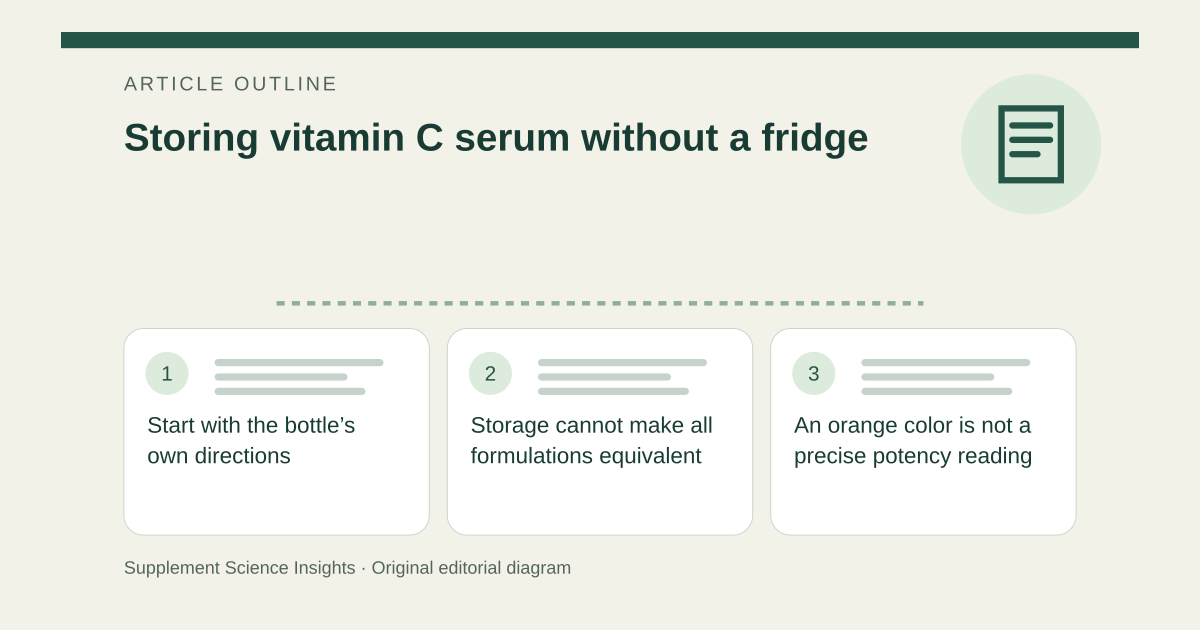
Start with the bottle’s own directions
The Ordinary’s FAQ recommends a cool, dry place away from direct sunlight and room-temperature storage for most of its products, with specified exceptions. That supports checking a product’s instructions rather than buying a fridge solely because the ingredient is vitamin C. Another manufacturer may specify different conditions. [1]
Storage cannot make all formulations equivalent
Vitamin C stability depends on chemical form, vehicle and packaging. A derivative and an ascorbic-acid serum need not change at the same rate. Good storage helps preserve the intended formulation; it does not turn a poorly characterized product into a proven treatment. [2]
An orange color is not a precise potency reading
Compare the bottle with its original appearance and manufacturer guidance. Color alone cannot measure its remaining vitamin concentration or verify microbial safety. Do not assume that every initially tinted formula is spoiled or that every pale serum remains effective indefinitely. [2]
Track opening as well as the purchase date
Use the period-after-opening or expiry information supplied for the product. If its condition is uncertain, contact the manufacturer rather than trying to restore it by adding water or another ingredient. Cooling a changed product is not evidence that its original composition has been restored. [1][2]
Choose a suitable location before adding equipment
Imagine a serum’s instructions permit room temperature but the bottle sits in direct sun. Moving it to an appropriate storage spot follows the instruction more directly than assuming refrigeration can undo previous exposure. Check the actual formula before changing storage conditions. [1]
| Check | Purpose |
|---|---|
| Label conditions | Use formula-specific instructions |
| Opening date | Track the stated use period |
| Unexpected change | Ask the manufacturer; avoid guessing potency |
Sources for this article
- Frequently Asked Questions | The Ordinary | The Ordinary
Source consulted: 2026-09-21. This is a reference resource, not a claim that we conducted the studies or tested a product. - The Roles of Vitamin C in Skin Health - PMC
Source consulted: 2026-09-21. This is a reference resource, not a claim that we conducted the studies or tested a product.