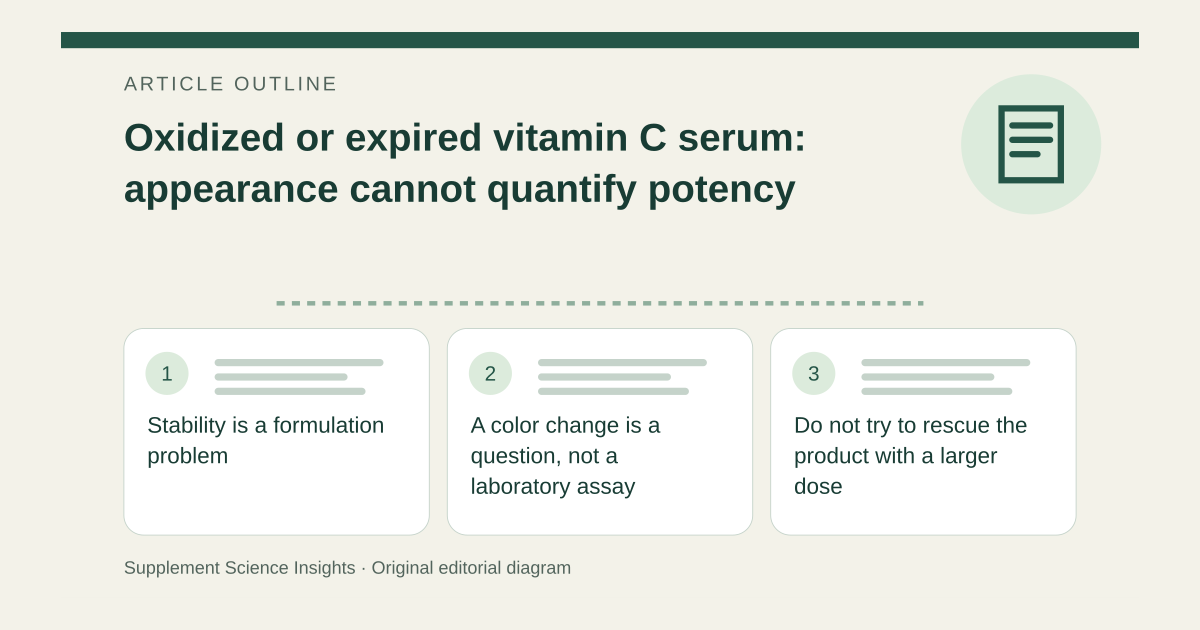
Stability is a formulation problem
Ascorbic acid can be unstable in a topical preparation, and packaging, vehicle and other ingredients affect performance. Derivatives are used partly to address such challenges, but they are not all interchangeable. A changed bottle cannot be evaluated simply by applying the same rule to every product called vitamin C. [1]
A color change is a question, not a laboratory assay
If the serum changes from its original appearance, consult the manufacturer’s guidance and stop using a product that is suspect or beyond its stated use period. Some formulas start with color from other ingredients. Neither pale color nor dark color alone provides an exact remaining vitamin concentration, microbial test or guaranteed outcome. [2]
Do not try to rescue the product with a larger dose
Imagine an old serum seems less effective, so the user applies twice as much. That does not restore a degraded formulation and adds uncertainty about tolerance. Replace a questionable product according to its directions rather than diluting it, mixing it with another active or taste-testing it. [1]
| Example | Interpretation |
|---|---|
| Changed appearance | Check the original formula and guidance |
| Printed expiry and opening period | Relevant product-specific information |
| More of an old serum | Does not restore validated potency |
Sources for this article
- The Roles of Vitamin C in Skin Health - PMC
Source consulted: 2026-09-20. This is a reference resource, not a claim that we conducted the studies or tested a product. - Topical Vitamin C and the Skin: Mechanisms of Action and Clinical Applications - PMC
Source consulted: 2026-09-20. This is a reference resource, not a claim that we conducted the studies or tested a product.