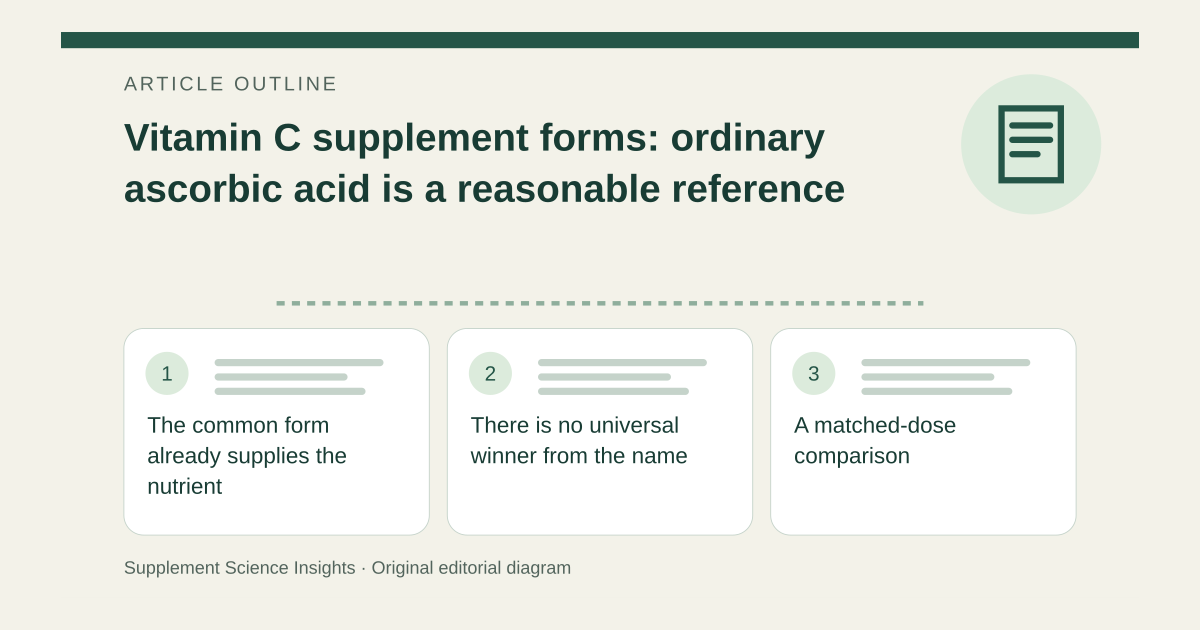
The common form already supplies the nutrient
Ascorbic acid is a common supplemental form of vitamin C. NIH ODS reports bioavailability equivalent to naturally occurring ascorbic acid in foods. Other products use mineral ascorbates such as calcium or sodium ascorbate, or combinations such as Ester-C. These are formulations of the same nutrient, not separate vitamin requirements. [1]
There is no universal winner from the name
ODS describes limited comparative evidence among supplemental forms. A difference in a blood or cell measurement does not automatically prove fewer infections or better long-term health. Additional mineral ingredients and the person’s tolerance may matter, but an expensive form is not inherently better because its name sounds more advanced. [1]
A matched-dose comparison
Imagine two products each declare 250 mg vitamin C, one as ascorbic acid and another as calcium ascorbate. Both contribute the stated 250 mg vitamin C; the second has an additional mineral context to inspect. Compare actual serving size, full ingredients and the reason for supplementation. A form change does not remove the total-intake upper limit. [1]
| Hypothetical option | Relevant check |
|---|---|
| Ascorbic acid 250 mg | Vitamin C amount and tolerance |
| Mineral ascorbate 250 mg vitamin C | Additional mineral content |
| Premium branded form | Evidence beyond the name |
Sources for this article
- Vitamin C - Health Professional Fact Sheet
Source consulted: 2026-09-20. This is a reference resource, not a claim that we conducted the studies or tested a product.