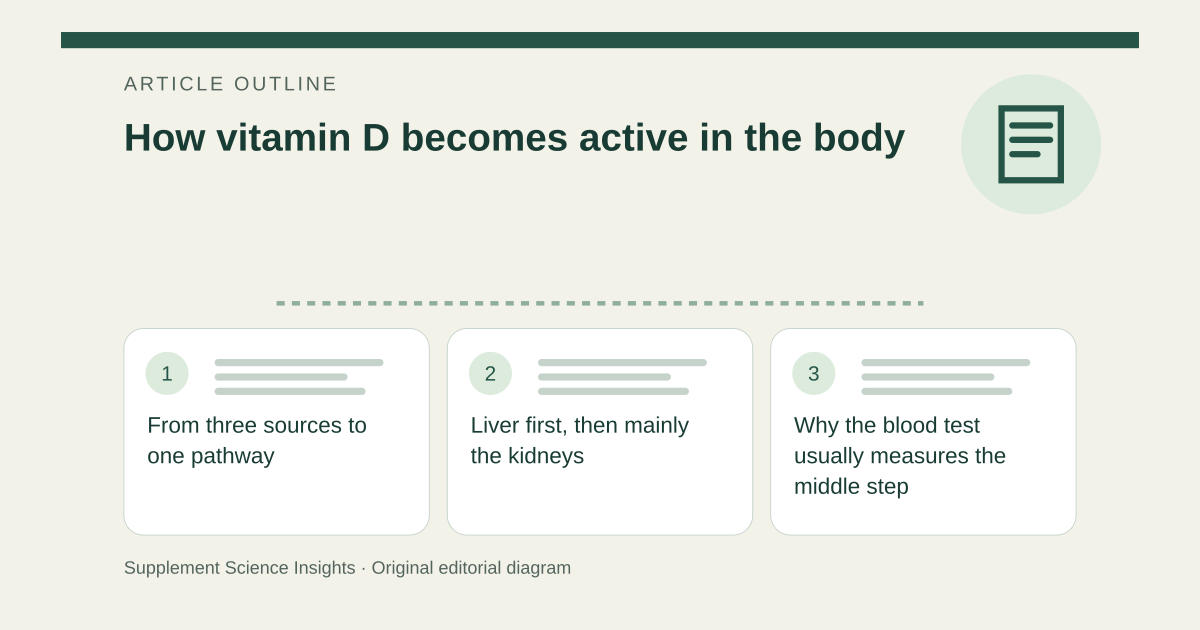
From three sources to one pathway
Vitamin D enters the body through food and supplements, and the skin can make it after ultraviolet exposure. These starting forms are not already the active hormone. They undergo chemical changes that allow vitamin D to participate in calcium and phosphate regulation. [1]
The dietary names D2 and D3 identify starting forms. They do not name the final active hormone. This distinction explains why the amount swallowed, the concentration measured in a blood test and the strength of an active prescription medicine are different quantities. [1]
Liver first, then mainly the kidneys
The first conversion adds a hydroxyl group in the liver, producing 25-hydroxyvitamin D, written 25(OH)D and also called calcidiol. A second hydroxylation occurs primarily in the kidneys, producing 1,25-dihydroxyvitamin D, written 1,25(OH)2D and called calcitriol. [1]
Calcitriol helps regulate calcium absorption and the mineral balance needed for bone. The pathway is regulated; it is not simply a pipe in which doubling the intake necessarily doubles the active hormone. A normal physiological role also does not establish that extra vitamin D improves every condition associated with a low blood level. [1]
Why the blood test usually measures the middle step
Serum 25(OH)D is the main marker used to assess vitamin D status because it reflects vitamin D obtained from several sources and persists longer in circulation. The active hormone is more tightly regulated and has a much shorter circulating life. Its concentration can therefore be a poor stand-alone measure of the body's vitamin D supply. [1]
Interpreting a result requires the test name, units and clinical setting. A person should not switch from an ordinary supplement to an active vitamin D medicine merely because both names contain vitamin D. Disorders affecting activation need clinical assessment, not an assumed dose conversion. [1]
Following a hypothetical laboratory report
Imagine a report lists “25-hydroxyvitamin D.” That result refers to the intermediate used to assess supply, not a direct measurement of the active hormone. Write out the complete analyte name before comparing two reports. A 1,25-dihydroxyvitamin D result answers a different question and should not be plotted as though it were the same test. [1]
| Name | Place in the pathway |
|---|---|
| Vitamin D2 or D3 | Starting nutrient form |
| 25(OH)D | Intermediate and usual status marker |
| 1,25(OH)2D | Active hormone |
Sources for this article
- Vitamin D - Health Professional Fact Sheet
Source consulted: 2026-09-20. This is a reference resource, not a claim that we conducted the studies or tested a product.