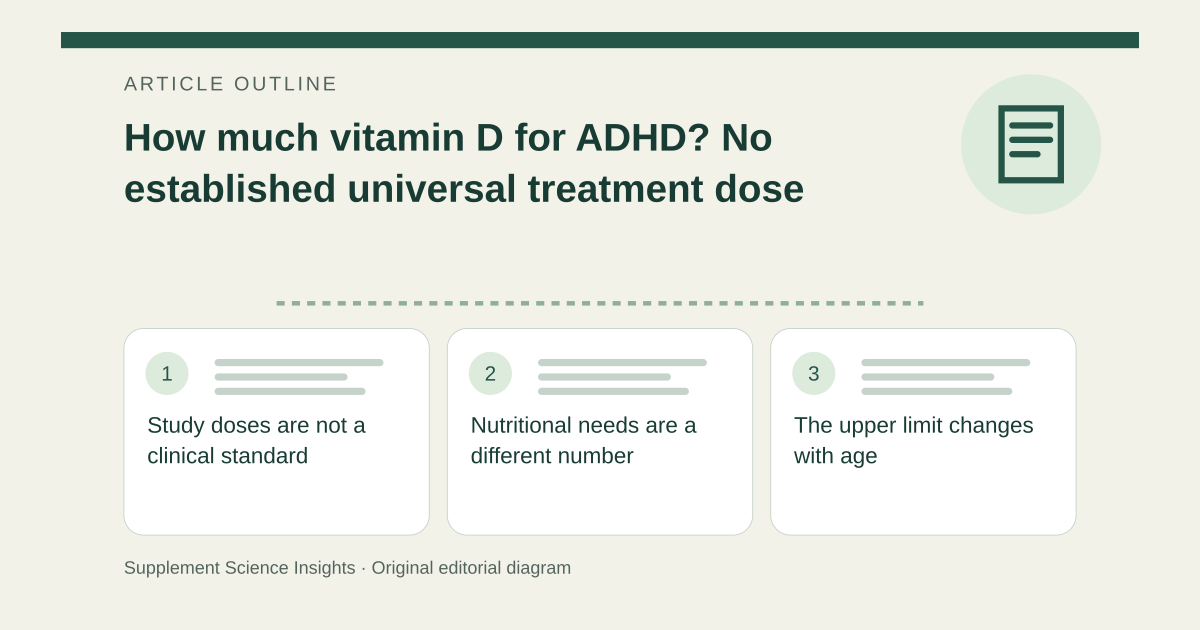
Study doses are not a clinical standard
An overview of systematic reviews describes limited trials adding vitamin D to methylphenidate. Some symptom measures improved, but the evidence does not establish vitamin D as a stand-alone replacement or define a reliable dose for children and adults with ADHD. The authors call for better trials to guide supplementation recommendations. [1]
Nutritional needs are a different number
NIH recommends a total intake of 600 IU daily from age one through age seventy under minimal-sun-exposure assumptions. This is a general nutritional recommendation, not an ADHD treatment dose. An established deficiency may require a clinician-directed regimen that differs from ordinary maintenance intake. [2]
The upper limit changes with age
NIH lists total daily upper intake levels of 2,500 IU for ages one to three, 3,000 IU for ages four to eight and 4,000 IU from age nine onward. These are safety limits for usual use, not targets for improving attention. A prescribed short treatment course should not be generalized to other children. [2]
Monitor the reason for treatment
Vitamin D status and ADHD-related functioning are distinct outcomes. A normalized blood result does not establish that inattention or impulsivity has been treated. NIMH describes ADHD care based on the diagnosis, impairment and individual treatment needs, which should continue to be assessed directly. [3][1]
Review the complete intake
Imagine a child receives vitamin D from a multivitamin plus a separate high-dose product. Add the amounts and review the labels with the treating clinician before assuming that more will improve attention. The appropriate question is the child's nutritional need and safety, not the highest dose seen in research. [2]
| Number | What it represents |
|---|---|
| 600 IU daily from age one | General total nutritional intake |
| Age-specific upper limit | Safety boundary, not an ADHD target |
| Study intervention amount | Research protocol in a defined population |
| Prescribed deficiency regimen | Individual treatment requiring follow-up |
Sources for this article
- The Relationship Between Vitamin D and the Development and Treatment of Attention-Deficit Hyperactivity Disorder: An Overview of Systematic Reviews - PMC
Source consulted: 2026-09-21. This is a reference resource, not a claim that we conducted the studies or tested a product. - Vitamin D - Health Professional Fact Sheet
Source consulted: 2026-09-21. This is a reference resource, not a claim that we conducted the studies or tested a product. - Attention-Deficit/Hyperactivity Disorder (ADHD) - National Institute of Mental Health (NIMH)
Source consulted: 2026-09-21. This is a reference resource, not a claim that we conducted the studies or tested a product.