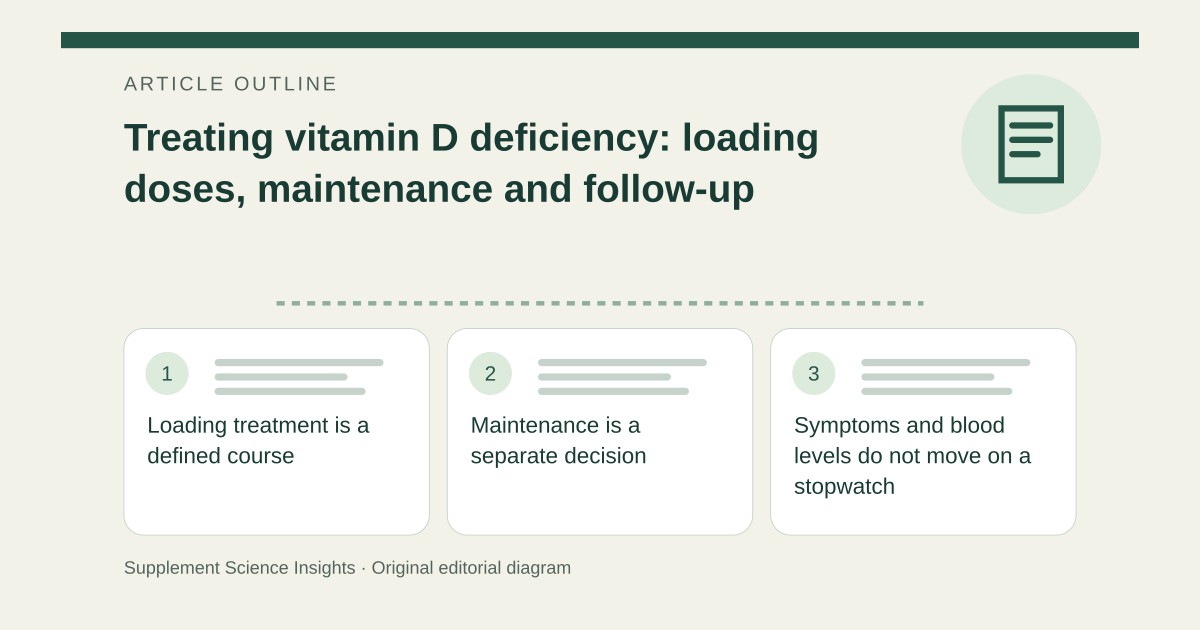
Loading treatment is a defined course
NHS describes adult loading courses for severe deficiency lasting about six to ten weeks, followed when needed by maintenance treatment. Its examples include 50,000 IU once weekly for six weeks. This is a prescribed regimen, not permission to take that amount daily or continue it indefinitely. [1]
Maintenance is a separate decision
NHS lists 800–2,000 IU daily as a possible prescribed maintenance range after loading. Prevention doses, maintenance after deficiency and treatment for impaired absorption have different purposes. One microgram equals 40 IU. Check both the unit and the schedule before combining products. [1][2]
Symptoms and blood levels do not move on a stopwatch
NHS notes that vitamin D levels may take weeks or months to rise and a person may not feel different. Follow the clinician’s testing plan rather than increasing the dose because fatigue remains. Persistent symptoms can need a separate explanation. [3]
Do not turn a weekly instruction into a daily habit
Imagine a prescription says one high-strength capsule weekly for a fixed course. Put the dates on a calendar and confirm when maintenance begins. Bring other vitamin D products to the medication review; an upper intake limit is not the same thing as a supervised treatment regimen. [1][2]
| Question | What determines the answer |
|---|---|
| Loading course | Severity and prescribed schedule |
| Maintenance | Ongoing intake and risk factors |
| No immediate symptom change | Follow-up rather than self-escalation |
Sources for this article
- How and when to take colecalciferol - NHS
Source consulted: 2026-09-20. This is a reference resource, not a claim that we conducted the studies or tested a product. - Vitamin D - Health Professional Fact Sheet
Source consulted: 2026-09-20. This is a reference resource, not a claim that we conducted the studies or tested a product. - About colecalciferol - NHS
Source consulted: 2026-09-20. This is a reference resource, not a claim that we conducted the studies or tested a product.