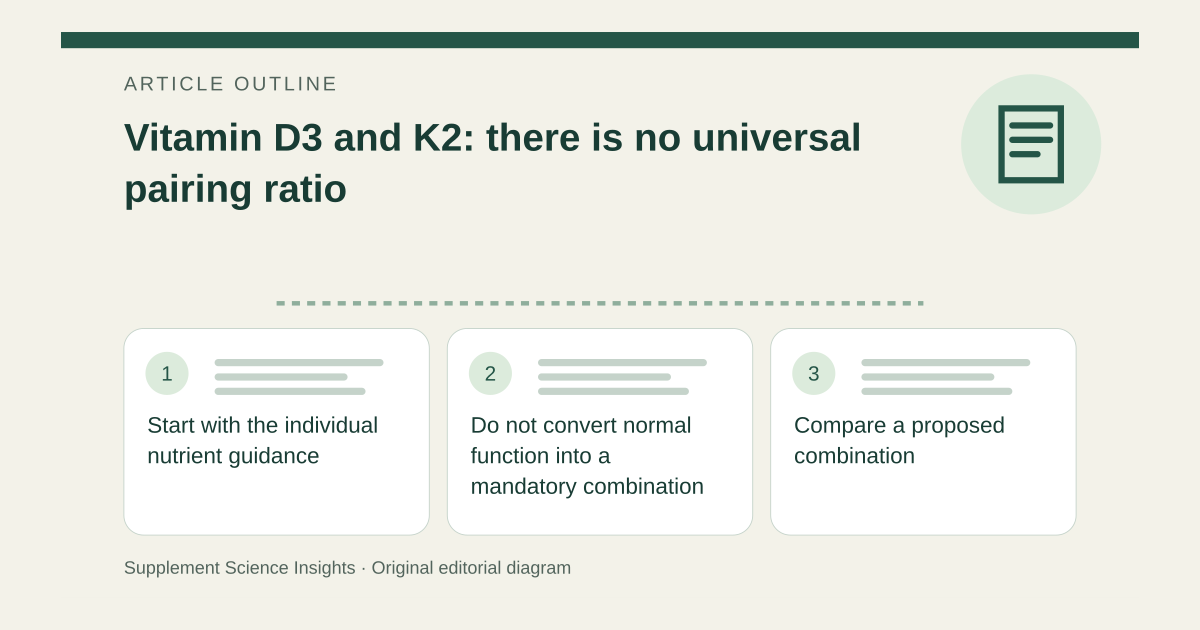
Start with the individual nutrient guidance
The general vitamin D recommendation is 600 IU daily from age one through seventy and 800 IU above seventy. These reference values include total intake and are not deficiency-treatment regimens. Adult vitamin K adequate intakes are 120 mcg for men and 90 mcg for women; they concern total vitamin K, not a separately established K2 requirement. [1][2]
Do not convert normal function into a mandatory combination
Vitamin D supports calcium handling and vitamin K participates in proteins involved in clotting and bone metabolism. These mechanisms do not define a universal D3:K2 ratio. The cited guidance also does not establish that K2 makes excessive D intake safe. Warfarin users need consistent vitamin K intake and professional review before changing a K-containing supplement. [1][2]
Compare a proposed combination
Imagine a label provides 25 mcg D3 and 100 mcg K2 per serving. The D3 equals 1,000 IU; the K2 amount must still be considered in the context of food, medicines and purpose. Compare exact forms, serving sizes and credible quality documentation rather than choosing by an advertised ideal ratio. Follow the product or clinical timing instructions. [1][2]
| Hypothetical combined label | What to assess |
|---|---|
| 25 mcg D3 | 1,000 IU; count all D sources |
| 100 mcg K2 | Vitamin K and medication context |
| Claimed ideal ratio | Requires evidence beyond normal nutrient roles |
Sources for this article
- Vitamin D - Health Professional Fact Sheet
Source consulted: 2026-09-20. This is a reference resource, not a claim that we conducted the studies or tested a product. - Vitamin K - Health Professional Fact Sheet
Source consulted: 2026-09-20. This is a reference resource, not a claim that we conducted the studies or tested a product.