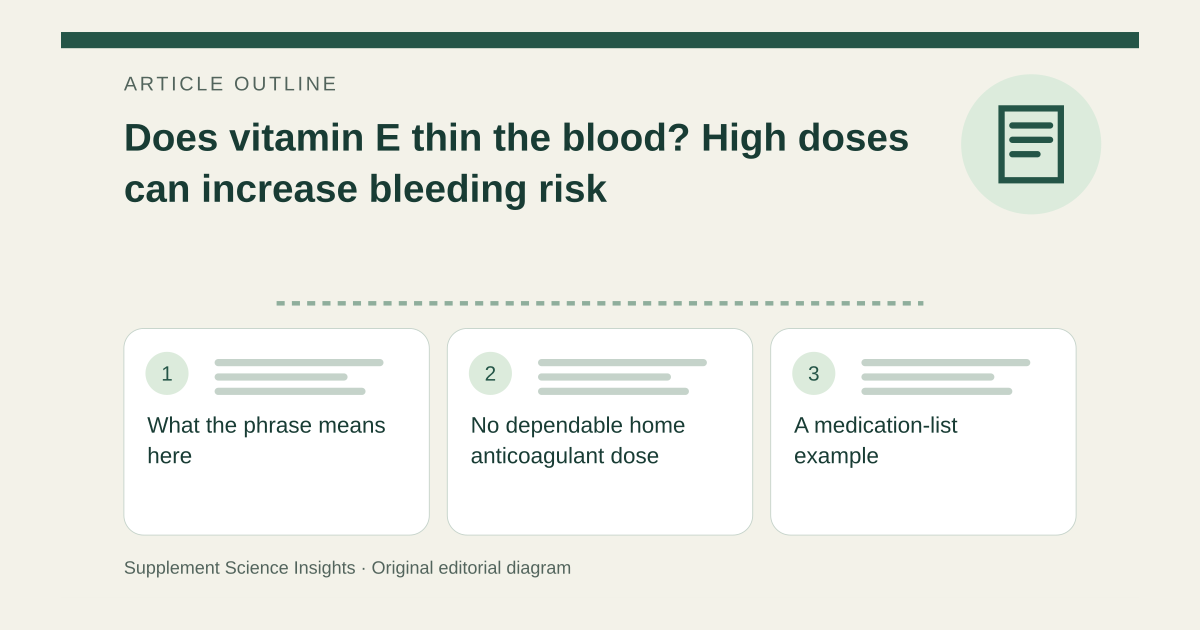
What the phrase means here
ODS describes inhibition of platelet aggregation and effects on vitamin-K-dependent clotting factors. These mechanisms help explain bleeding concerns with large supplemental amounts, particularly alongside medicines affecting clotting. They do not establish a safe vitamin E dose to prevent a heart attack, stroke or clot in an individual. [1]
No dependable home anticoagulant dose
The clinically significant interaction threshold is uncertain. The adult supplemental upper limit is a population safety boundary, not a target or a promise of safety with anticoagulants. Do not change a prescribed medicine or add high-dose vitamin E to intensify its effect. Unusual or significant bleeding requires medical assessment. [1]
A medication-list example
Imagine a person taking warfarin also uses a multivitamin and a separate high-dose vitamin E capsule. The prescriber needs both labels, amounts and frequency. A pharmacist can also help interpret older IU labels, whose conversion differs between natural and synthetic alpha-tocopherol. Taking the products several hours apart does not establish that the combined bleeding risk disappears. [1]
| Hypothetical situation | Appropriate interpretation |
|---|---|
| High-dose E plus anticoagulant | Potential additive bleeding concern |
| Changing time of day | Does not establish interaction prevention |
| Using E instead of prescribed therapy | Not an equivalent treatment |
Sources for this article
- Vitamin E - Health Professional Fact Sheet
Source consulted: 2026-09-20. This is a reference resource, not a claim that we conducted the studies or tested a product.