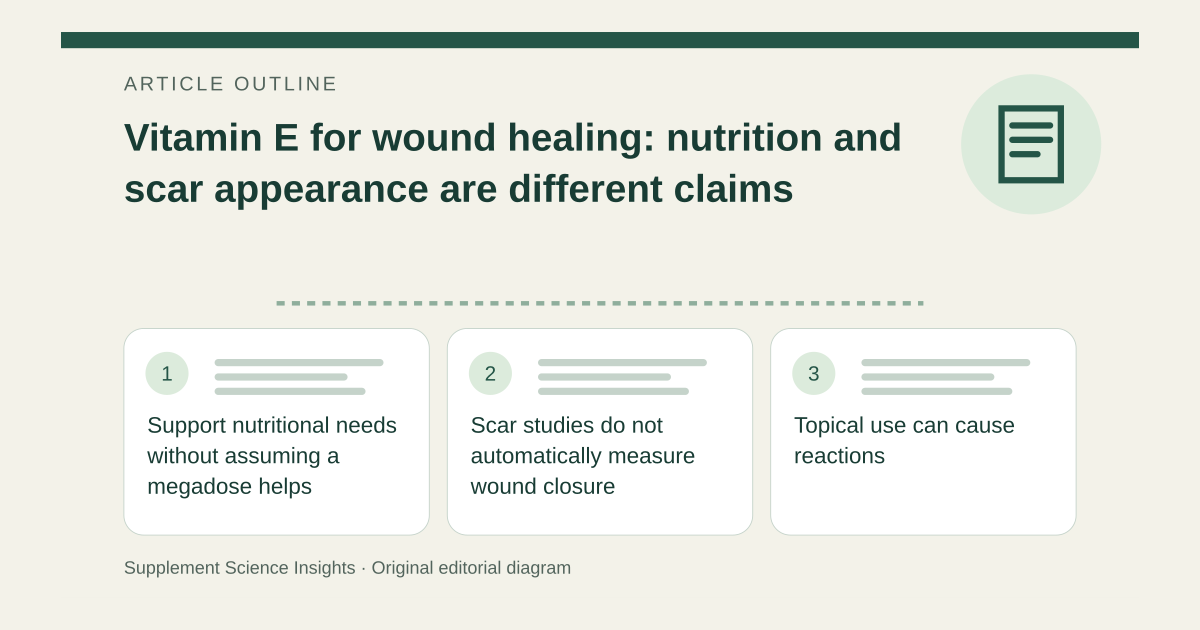
Support nutritional needs without assuming a megadose helps
Wound-recovery guidance emphasizes adequate energy, protein and a range of nutrients. Vitamin E has normal physiological roles, but a nutritional requirement is not proof that extra supplementation accelerates healing when intake is already adequate. [1][2]
Scar studies do not automatically measure wound closure
A 2016 systematic review of six prospective studies found insufficient evidence to justify widespread topical vitamin E alone for improving scar appearance. Some studies reported benefit, including combination treatments, while others did not. A cosmetic endpoint should not be rewritten as faster closure or lower infection risk. [3]
Topical use can cause reactions
The review reported contact dermatitis, itching or rash in some studies. Breaking open an oral capsule does not create a wound-care preparation with established suitability. Follow the clinician’s instructions after surgery rather than applying an improvised mixture to an open wound. [3][4][5]
Use established care for a minor wound
AAD advises gentle cleaning, keeping a minor wound moist with petroleum jelly or a suitable ointment, and protecting it with a dressing. Follow specific instructions for stitches and seek care for deeper or concerning injuries. Once healed, appropriate sun protection can reduce discoloration. [5]
Choose the outcome before choosing the product
Imagine a closed surgical scar is red but the wound has already healed. That is a different question from an open wound that is not closing. Ask about the appropriate scar or wound plan instead of assuming vitamin E treats both problems. [5][3]
| Concern | Relevant question |
|---|---|
| Poor intake during recovery | Are energy and nutrient needs met? |
| Open wound | What wound care is appropriate? |
| Closed visible scar | What scar treatment is suitable? |
| Itching after an oil | Could the product be irritating? |
Sources for this article
- Dietary information to promote wound healing — Oxford University Hospitals
Source consulted: 2026-09-21. This is a reference resource, not a claim that we conducted the studies or tested a product. - Vitamin E - Health Professional Fact Sheet
Source consulted: 2026-09-21. This is a reference resource, not a claim that we conducted the studies or tested a product. - The Role of Topical Vitamin E in Scar Management: A Systematic Review.
Source consulted: 2026-09-21. This is a reference resource, not a claim that we conducted the studies or tested a product. - Dietary Supplements: What You Need to Know
Source consulted: 2026-09-21. This is a reference resource, not a claim that we conducted the studies or tested a product. - Minimize a scar: Proper wound care tips from dermatologists
Source consulted: 2026-09-21. This is a reference resource, not a claim that we conducted the studies or tested a product.