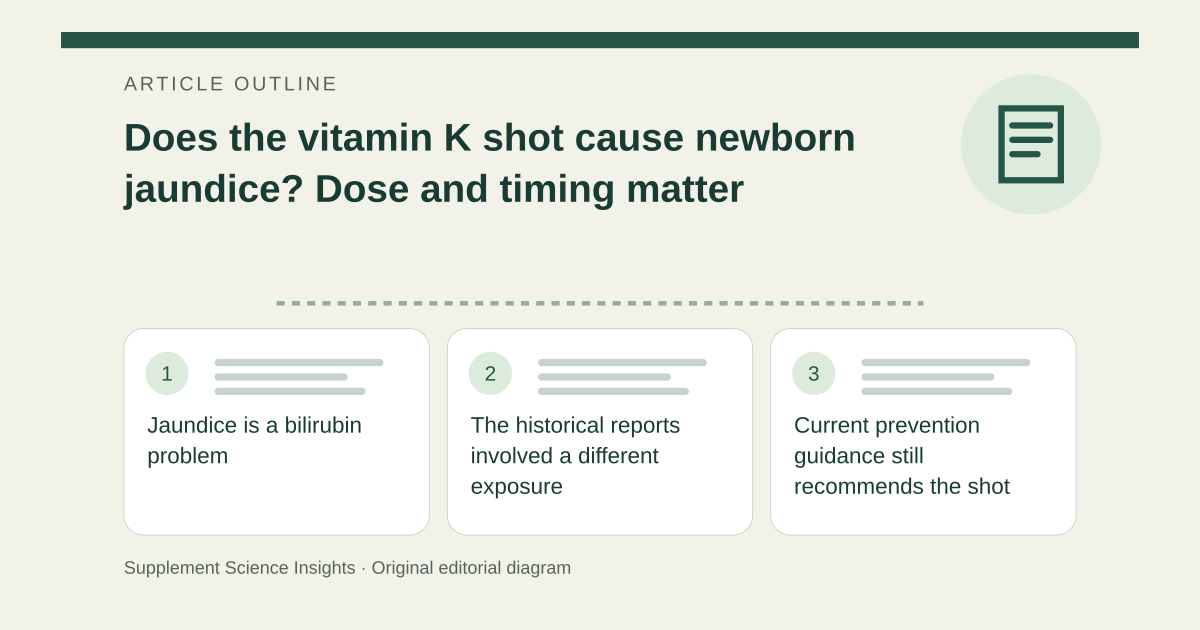
Jaundice is a bilirubin problem
NHS explains that newborn jaundice commonly occurs because the liver is not yet clearing bilirubin efficiently. Other causes include blood-group-related hemolysis, infection and liver problems. A yellow appearance after a birth intervention does not by itself establish that the intervention caused it. [1]
The historical reports involved a different exposure
Stanford’s neonatal guidance distinguishes older menadione use and very high vitamin K1 doses from routine newborn phytonadione prophylaxis. It reports that the historical jaundice problem has not occurred at normal therapeutic newborn doses. This is a dose-and-form distinction, not a claim that every possible use of vitamin K has zero adverse effects. [2]
Current prevention guidance still recommends the shot
AAP and CDC recommend newborn vitamin K to prevent potentially severe deficiency bleeding. The decision should weigh that established purpose rather than treating a common newborn condition as proof of an adverse reaction. Parents can ask the team about the actual preparation and expected effects. [3][4]
Evaluate jaundice promptly rather than guessing
NHS advises urgent assessment for suspected or worsening jaundice. Jaundice in the first twenty-four hours, difficulty waking, poor feeding, breathing problems or abnormal movements needs immediate care. Dark urine or pale stools also require prompt attention. A vitamin explanation must not delay evaluation. [1]
Compare timing with evidence
Imagine a baby receives vitamin K at birth and looks yellow on day three. The timing is compatible with common newborn jaundice, but only assessment can determine the cause and severity. The useful next step is bilirubin evaluation when indicated, not assuming the preventive shot was responsible. [1][2]
| Observation | What it does not prove |
|---|---|
| Yellow skin after an injection | Does not establish causation |
| Old high-dose toxicity report | Does not describe routine prophylaxis |
| Baby appears well | Does not replace bilirubin assessment |
| Early or worsening jaundice | Needs timely medical evaluation |
Sources for this article
- Jaundice in babies - NHS
Source consulted: 2026-09-21. This is a reference resource, not a claim that we conducted the studies or tested a product. - Vitamin K | Newborn Nursery | Stanford Medicine
Source consulted: 2026-09-21. This is a reference resource, not a claim that we conducted the studies or tested a product. - Why Your Newborn Needs a Vitamin K Shot - HealthyChildren.org
Source consulted: 2026-09-21. This is a reference resource, not a claim that we conducted the studies or tested a product. - Frequently Asked Questions About Vitamin K Deficiency Bleeding | Vitamin K Deficiency Bleeding | CDC
Source consulted: 2026-09-21. This is a reference resource, not a claim that we conducted the studies or tested a product.