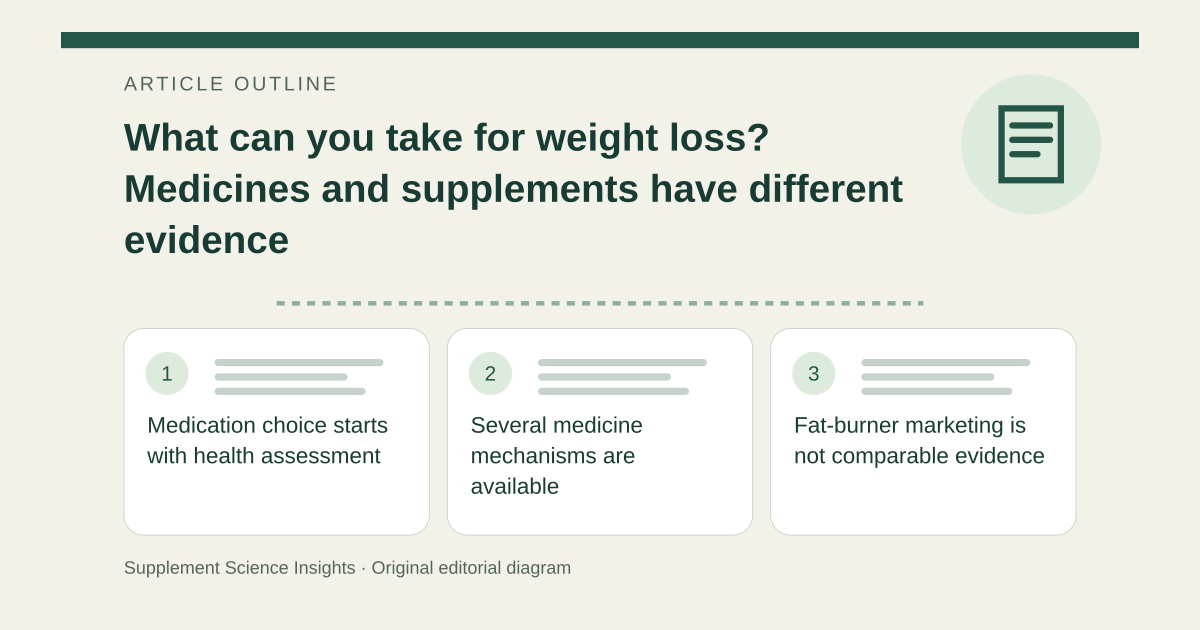
Medication choice starts with health assessment
NIDDK describes weight-management medicines as options for people with relevant overweight or obesity-related health needs when lifestyle measures alone are insufficient. Eligibility, medical history, other medicines and pregnancy plans affect the choice. The decision is about health benefit and risk, not simply the fastest scale change. [1]
Several medicine mechanisms are available
Examples include appetite-related medicines such as semaglutide or tirzepatide and orlistat, which reduces absorption of dietary fat. Lower-dose orlistat is also available without prescription in the United States. These are medicines with product-specific instructions and contraindications, not interchangeable supplements. [1]
Fat-burner marketing is not comparable evidence
NIH ODS describes weight-loss supplement evidence as uncertain and often limited by small, short studies or multi-ingredient formulations. A stimulant sensation, change in bowel movements or short-term water change does not by itself establish meaningful loss of body fat. Do not transfer an ingredient claim to an untested blend. [2]
Plan for monitoring and long-term use
Medicines work alongside eating, activity and behavioral support, and ongoing benefit and adverse effects need review. NIDDK advises against weight-loss medicines during pregnancy or when planning pregnancy. Review the exact current prescribing information with the clinician rather than using another person’s regimen. [1]
Do supplements sold as GLP-1 boosters actually work?
A GLP-1 booster claim is not evidence that a supplement contains a prescription GLP-1 receptor agonist or produces an equivalent weight-loss effect. A mechanism experiment, a temporary hormone change and sustained weight loss in people are different findings. Evidence about one ingredient also cannot establish that a multi-ingredient retail blend works. [3][4]
Before buying, look for a controlled human trial of the exact formulation, with a relevant comparator, duration, measured weight change, adverse effects and funding disclosures. Without that evidence, treat the finished-product claim as unverified, not as a proven substitute for prescribed treatment. This standard does not mean that every product marketed with the term has been studied and shown ineffective. [3][4]
Make the comparison concrete
Imagine choosing between a marketed metabolism capsule and a clinical weight-management appointment. Bring your medicines, previous attempts and health goals to the appointment. Ask about eligibility, expected benefit, side effects, costs and a follow-up plan; those factors are more useful than a promised number of pounds. [1][2]
| Question | Practical implication |
|---|---|
| Prescription option | Eligibility and ongoing clinical monitoring |
| OTC orlistat | A medicine with its own restrictions |
| Weight-loss supplement | Do not assume comparable efficacy |
Sources for this article
- Prescription Medications to Treat Overweight & Obesity - NIDDK
Source consulted: 2026-09-20. This is a reference resource, not a claim that we conducted the studies or tested a product. - Dietary Supplements for Weight Loss — NIH ODS
Source consulted: 2026-09-20. This is a reference resource, not a claim that we conducted the studies or tested a product. - NIDDK: prescription medications to treat overweight and obesity
Source consulted: 2026-09-25. This is a reference resource, not a claim that we conducted the studies or tested a product. - NIH ODS: Dietary supplements for weight loss, consumer fact sheet
Source consulted: 2026-09-25. This is a reference resource, not a claim that we conducted the studies or tested a product.