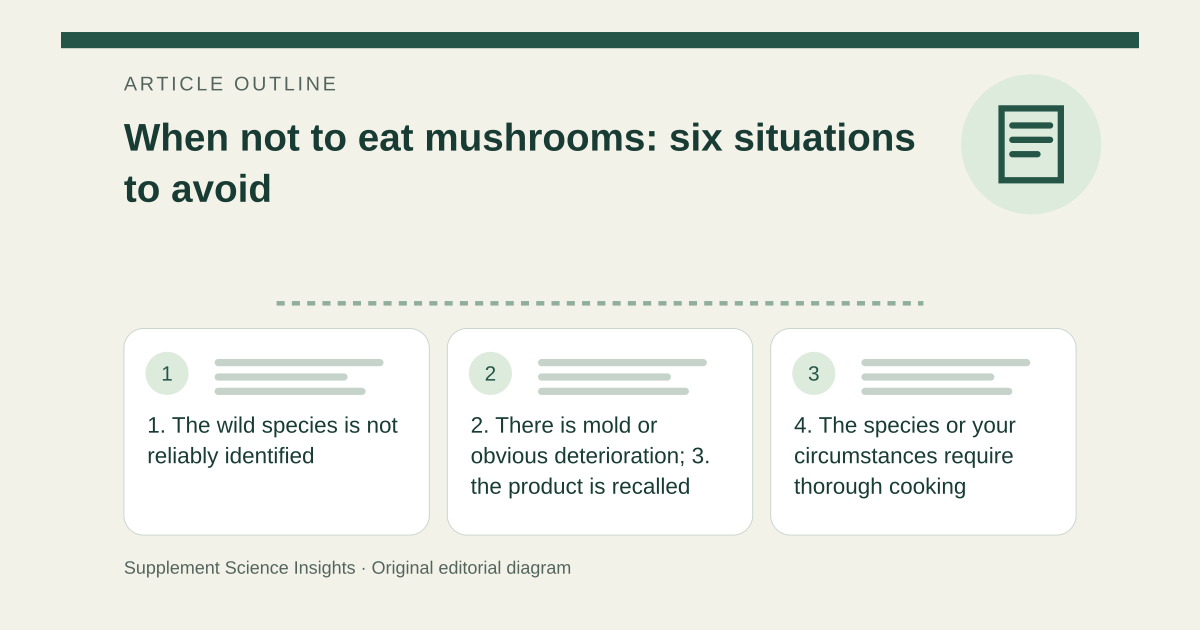
1. The wild species is not reliably identified
A photograph, color or cooking test cannot establish edibility. USU recommends purchasing from a reputable grower or grocer. OSU warns that poisonous mushroom toxins are not reliably destroyed by drying or cooking. [1][2]
2. There is mold or obvious deterioration; 3. the product is recalled
Choose firm, sound mushrooms rather than moldy or deteriorated specimens. If a product is subject to a recall, follow the recall instructions rather than trying to rescue it by cooking. CDC enoki investigations demonstrate that contamination can occur in commercially sold products too. [1][3]
4. The species or your circumstances require thorough cooking
CDC advises cooking enoki thoroughly and avoiding cross-contamination. People at increased Listeria risk, including pregnant people, older adults and those with weakened immunity, should avoid raw mushrooms and follow safer-food guidance. [3][4]
5. You have a relevant allergy; 6. storage safety is uncertain
Do not deliberately retest a mushroom that has caused a suspected serious allergic reaction without clinical advice. Refrigerate fresh mushrooms promptly and use appropriate preservation methods. Drying an already questionable specimen is not a safety reset. [5][1][2]
Choose the safer option when identity or handling is unclear
Imagine an unlabeled bag of foraged mushrooms has been left unrefrigerated. Neither a familiar smell nor a plan to fry them establishes safety. Discarding the uncertain food is more sensible than relying on a home identification or detoxification rule. [1][2]
| Question | Action boundary |
|---|---|
| Species known? | Unknown wild mushrooms are unsuitable |
| Sound and unrecalled? | Do not salvage suspect product |
| Appropriately cooked? | Species and personal risk matter |
| Storage and allergy history? | Resolve uncertainty before eating |
Sources for this article
- Fruit and Vegetable Guide Series: Mushrooms | USU
Source consulted: 2026-09-21. This is a reference resource, not a claim that we conducted the studies or tested a product. - Preserving mushrooms | OSU Extension Service
Source consulted: 2026-09-21. This is a reference resource, not a claim that we conducted the studies or tested a product. - Listeria Outbreak Linked to Enoki Mushrooms - November 2022 | Listeria Infection | CDC
Source consulted: 2026-09-21. This is a reference resource, not a claim that we conducted the studies or tested a product. - Preventing Listeria Infection | Listeria Infection | CDC
Source consulted: 2026-09-21. This is a reference resource, not a claim that we conducted the studies or tested a product. - Proteins from Edible Mushrooms: Nutritional Role and Contribution to Well-Being - PMC
Source consulted: 2026-09-21. This is a reference resource, not a claim that we conducted the studies or tested a product.