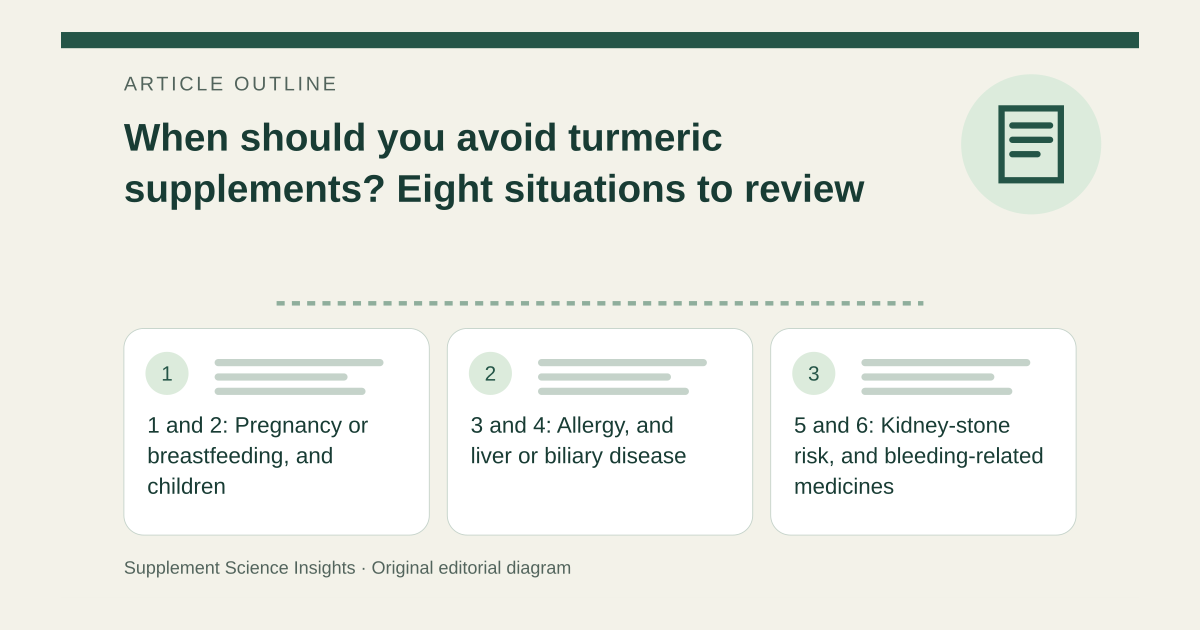
1 and 2: Pregnancy or breastfeeding, and children
NCCIH says turmeric supplements may be unsafe during pregnancy and that safety above ordinary food amounts during breastfeeding is poorly known. EMA does not recommend its medicinal preparations during pregnancy or lactation, or in those under eighteen because adequate data are lacking. These are supplement or medicinal-use cautions, not a blanket ban on seasoned meals. [1][2]
3 and 4: Allergy, and liver or biliary disease
Avoid a product that has caused an allergic reaction. EMA lists hypersensitivity as a contraindication and advises against medicinal turmeric with bile-duct obstruction, cholangitis, gallstones and other biliary or liver disease. NCCIH also reports liver injury with some enhanced-absorption products; dark urine or jaundice requires stopping the supplement and medical assessment. [2][1]
5 and 6: Kidney-stone risk, and bleeding-related medicines
MSK flags kidney-stone concerns with turmeric supplementation and possible increased bleeding risk with anticoagulants or antiplatelet medicines. The strength and type of evidence differ by concern. Discuss the exact product and relevant history rather than assuming that a natural supplement is automatically compatible with treatment. [3]
7 and 8: Cancer treatment, and transplant medicines
Oncology medicines require specialist review because effects can differ by drug and formulation; laboratory interaction findings do not establish the same outcome for every treatment. Tacrolimus also warrants careful review because of reported interaction concerns. Do not add turmeric or change an essential medicine independently. [3][4]
The list is a starting point, not clearance for everyone else
Imagine someone does not fit a listed category but takes several prescriptions and develops nausea after a high-absorption extract. They still need a product-specific review. Gastrointestinal intolerance, other interactions and formulation differences do not disappear because a checklist has eight headings. [1][3]
| Category | Main issue |
|---|---|
| Pregnancy, lactation or childhood | Insufficient or concerning safety evidence |
| Allergy | Avoid the triggering preparation |
| Liver or biliary disease | Specific medicinal-use precautions |
| Kidney-stone or bleeding concerns | History and medicine review |
| Cancer or transplant treatment | Specialist interaction assessment |
Sources for this article
- Turmeric: Usefulness and Safety | NCCIH
Source consulted: 2026-09-21. This is a reference resource, not a claim that we conducted the studies or tested a product. - European Union herbal monograph on Curcuma longa L., rhizoma - Revision 1
Source consulted: 2026-09-21. This is a reference resource, not a claim that we conducted the studies or tested a product. - Turmeric | Memorial Sloan Kettering Cancer Center
Source consulted: 2026-09-21. This is a reference resource, not a claim that we conducted the studies or tested a product. - Addendum to assessment report on Curcuma longa L., rhizoma - published 2026
Source consulted: 2026-09-21. This is a reference resource, not a claim that we conducted the studies or tested a product.