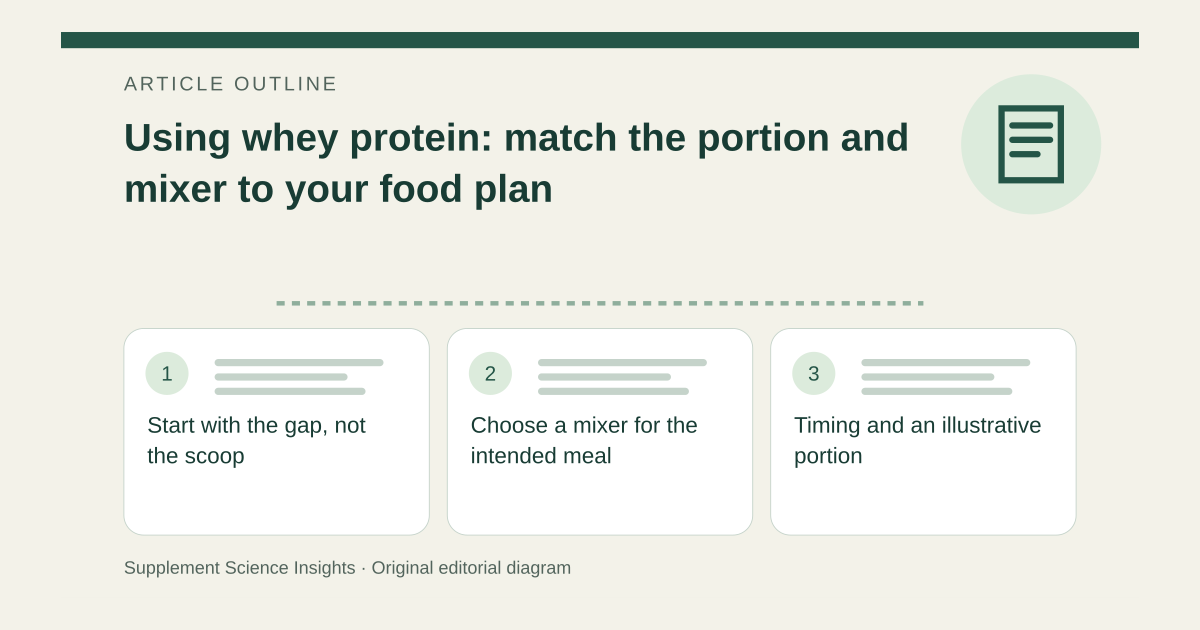
Start with the gap, not the scoop
Whey is a milk protein. The useful amount of powder depends on the protein already supplied by meals and the person’s needs. Powder weight and protein weight differ: a 30 g scoop might declare 24 g protein, with the remainder coming from other constituents. Use the actual label rather than assuming a scoop is pure protein. [1][2]
Choose a mixer for the intended meal
Water adds volume without adding protein or food energy. Milk, yogurt or a smoothie adds its own nutrients, so include those in the total. For a lighter addition, water may be convenient; for a more substantial snack, another food may fit. These are meal-design choices, not proof that a particular mixer produces superior muscle growth. Follow the product’s preparation directions. [2]
Timing and an illustrative portion
Protein supports recovery after training, but the ODS review also describes mixed evidence for a narrow timing advantage. A convenient meal or snack near training can work without treating a missed minute as failure. Imagine an individually chosen food plan is 20 g short: a product with 24 g protein per 30 g powder would supply 20 g in 25 g powder. That calculation is not a universal dose. [2]
| Hypothetical quantity | Calculation |
|---|---|
| 30 g powder supplies 24 g protein | 80% protein by declared weight |
| 25 g powder | 20 g protein |
| Milk added | Count its contribution separately |
Sources for this article
- Whey vs. Casein Protein: Difference Explained | U.S. Dairy
Source consulted: 2026-09-20. This is a reference resource, not a claim that we conducted the studies or tested a product. - Dietary Supplements for Exercise and Athletic Performance - Health Professional Fact Sheet
Source consulted: 2026-09-20. This is a reference resource, not a claim that we conducted the studies or tested a product.