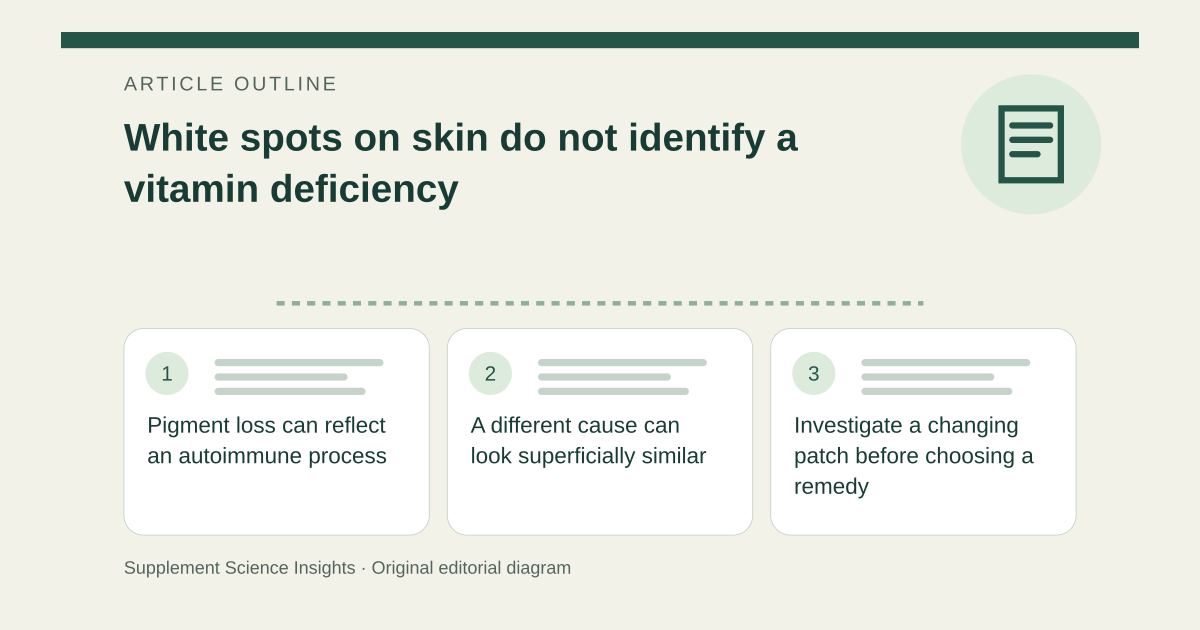
Pigment loss can reflect an autoimmune process
NIAMS describes vitiligo as loss of pigment when the immune system attacks pigment-producing cells. That mechanism is not equivalent to running out of a vitamin. Its distribution and course vary, and the diagnosis is based on clinical assessment. [1]
A different cause can look superficially similar
NHS describes pityriasis versicolor as a fungal condition that changes skin color, sometimes producing paler patches with scale or itch. Treatment is directed at that condition. These examples are not an exhaustive list and are not a way to diagnose a patch from a webpage. [2]
Investigate a changing patch before choosing a remedy
Imagine a new pale patch leads someone to take vitamin tablets for weeks. That delays identifying whether pigment loss, a fungal condition or another skin problem is involved. Ask a clinician about new or changing discoloration; nutritional testing, if appropriate, follows the broader assessment. [2][1]
| Observation | Interpretation |
|---|---|
| Milky-white pigment loss | One possible pattern in vitiligo |
| Pale scaly patches | Can have a fungal cause |
| Color alone | Cannot identify a deficiency |
Sources for this article
- Vitiligo Symptoms, Risk Factors, & Causes | NIAMS
Source consulted: 2026-09-20. This is a reference resource, not a claim that we conducted the studies or tested a product. - Pityriasis versicolor - NHS
Source consulted: 2026-09-20. This is a reference resource, not a claim that we conducted the studies or tested a product.