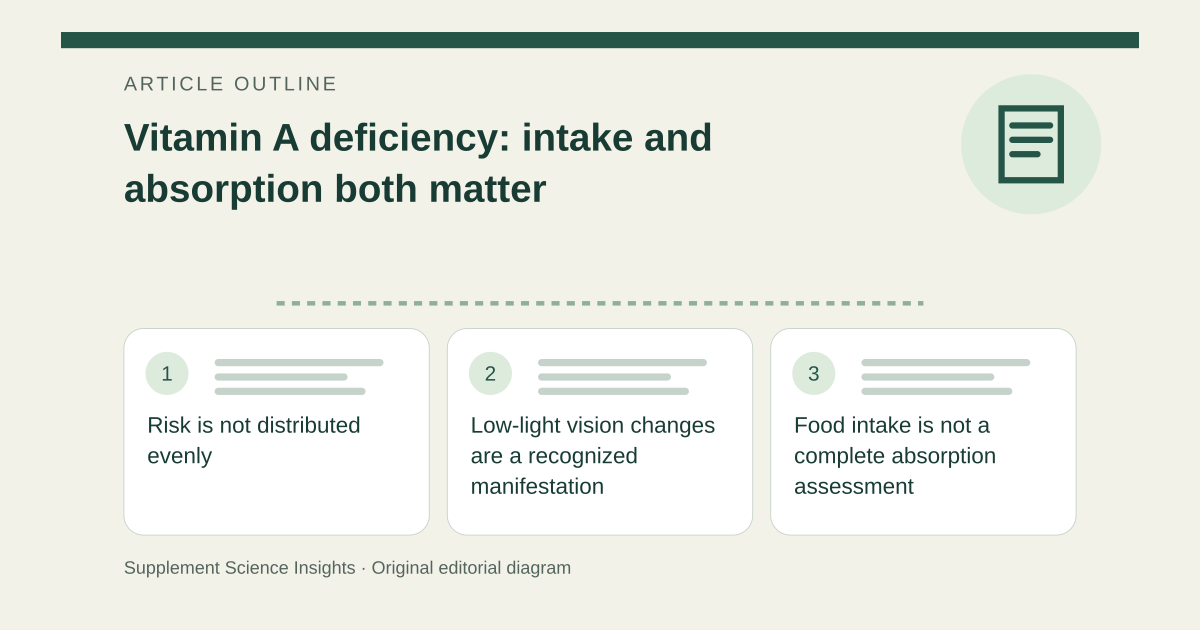
Risk is not distributed evenly
ODS describes overt vitamin A deficiency as uncommon in the United States but still important in settings where access to vitamin-A-containing foods is limited. Preterm infants can also begin life with low stores. [1]
Digestive conditions can change risk even when vitamin A appears in the diet. ODS identifies cystic fibrosis and some gastrointestinal disorders among contexts requiring attention to status. [1]
Low-light vision changes are a recognized manifestation
Vitamin A deficiency can cause night blindness and progress to more serious eye damage, including corneal involvement. This reflects the nutrient’s role in the visual system, not a promise that extra vitamin A improves every vision problem. [1]
A new visual symptom needs evaluation rather than a self-diagnosis of deficiency. The cause, severity and appropriate treatment cannot be selected from one symptom alone. [1]
Food intake is not a complete absorption assessment
Imagine someone with a gastrointestinal disorder regularly eats vitamin-A-containing foods. The food list describes intake, but it does not prove that absorption and body stores are adequate.
Conversely, a short food diary with few sources is not enough to diagnose deficiency. Clinical history and appropriate assessment provide additional information.
| Detail | Interpretation |
|---|---|
| Low recorded intake | A possible risk clue |
| A malabsorptive condition | A separate risk factor |
| Night-vision difficulty | Requires assessment, not self-dosing |
Avoid treating uncertainty with a high amount
Excess preformed vitamin A can be harmful, so suspected deficiency is not a reason to escalate supplements without assessing the situation. Existing disease can change the treatment approach. [1]
This page summarizes risk factors and manifestations. It does not prescribe a replacement regimen, interpret an individual laboratory result or provide an infant treatment plan. [1]
Sources for this article
- NIH ODS: Vitamin A and Carotenoids
Source consulted: 2026-09-17. This is a reference resource, not a claim that we conducted the studies or tested a product.